Math Trailhead

Worksheet Transformations

1.

Describe how the given equation represents a transformation of the function \(f(x)\text{:}\)
Answer 1.
\(\text{left 8 units}\)
Answer 2.
\(\text{right 8 ... 10 units}\)

3.

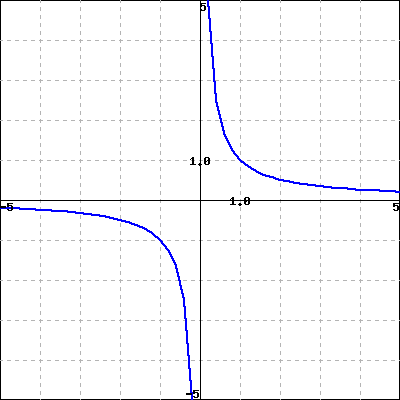
Let \(\displaystyle{f(x) = \frac{1}{x}}\text{.}\) Find \(g(x)\text{,}\) the function that is \(f(x)\) shifted down \(10\) units and right \(3\) units.
\(g(x) =\)
Hint.
Given a function, \(f(x)\text{,}\) a new function \(g(x) = f(x) +k\) is a vertical shift of the function \(f(x)\text{.}\) If \(k\) is positive the function is shifted up \(k\) units, if \(k\) is negative the function is shifted down \(k\) units.
Given a function, \(f(x)\text{,}\) a new function \(g(x) = f(x-h)\) is a horizontal shift of the function \(f(x)\text{.}\) If \(h\) is positive the function is shifted right \(h\) units, if \(h\) is negative the function is shifted left \(h\) units.
Example: \(g(x) = \sqrt{x-4}-5\) is the function \(f(x) =\sqrt{x}\) shifted right 4 units and down 5 units.
Answer.
\(\frac{1}{x-3}-10\)

4.

Describe how the given equation represents a transformation of the function \(f(x)\text{:}\)
Answer 1.
\(\text{vertical stretch}\)
Answer 2.
\(\text{vertical compression}\)

5.

Describe how the given equation represents a transformation of the function \(f(x)\text{:}\)
Answer 1.
\(\text{horizontal compression}\)
Answer 2.
\(\text{horizontal stretch}\)

6.

Suppose \(f(t) = 4 t + 3\text{.}\)
(a) Find \(2 f(t)\) and \(f(2t)\text{.}\)
\(2f(t) =\)
\(f(2t) =\)
(b) Solve the equation \(2 f(t) = f(2t)\text{.}\) Does the equation \(2 f(t) = f(2t)\) have no solution, one solution, or infinitely many solutions?
If it has no solution, enter NONE. If it has one solution, enter your solution as an equation \(t = a\) for some number \(a\text{.}\) If it has infinitely many solutions, enter an equation \(y = b + m t\) for some numbers \(b\) and \(m\text{.}\)
Answer 1.
\(2\mathopen{}\left(4t+3\right)\)
Answer 2.
\(4\cdot 2t+3\)
Answer 3.
\(\text{no solution}\)
Answer 4.
\(\text{NONE}\)

7.

(a) The graph of \(y = f(3 x)\) is the graph of \(y = f(x)\)
scaled horizontally and
scaled vertically .
(b) The graph of \(y = 5 f(x)\) is the graph of \(y = f(x)\)
scaled horizontally and
scaled vertically .
(c) The graph of \(y = 2 f(5 x)\) is the graph of \(y = f(x)\)
scaled horizontally and
scaled vertically .
(d) The graph of \(y = \frac{1}{4} f\left( \frac{x}{3} \right)\) is the graph of \(y = f(x)\)
scaled horizontally and
scaled vertically .
Answer 1.
\(\text{by compression by a factor of 3}\)
Answer 2.
\(\text{no vertical scaling}\)
Answer 3.
\(\text{no horizontal scaling}\)
Answer 4.
\(\text{by expansion by a factor of 5}\)
Answer 5.
\(\text{by compression by a factor of 5}\)
Answer 6.
\(\text{by expansion by a factor of 2}\)
Answer 7.
\(\text{by expansion by a factor of 3}\)
Answer 8.
\(\text{by compression by a factor of 4}\)

8.

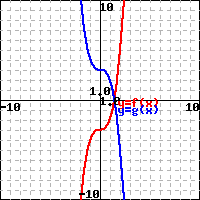
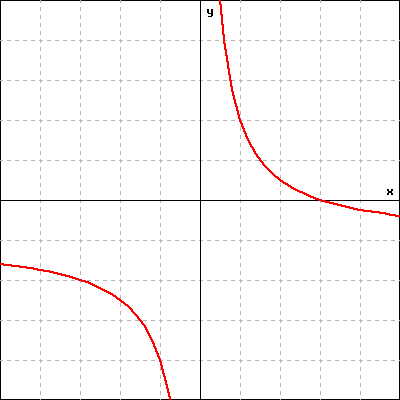
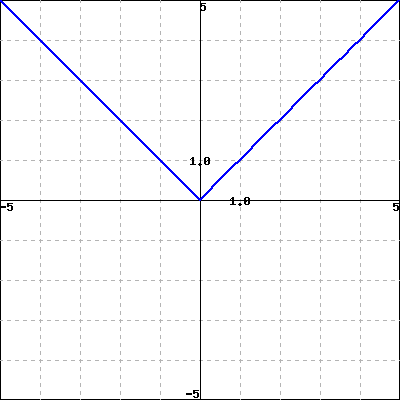
Use the two graphs below to answer the following questions.
(a) The graph of \(y = g(x)\) is the graph of \(y = f(x)\)
scaled horizontally and
scaled vertically .
(b) Find an equation for \(g(x)\) in terms of the function \(f(x)\text{.}\) For example, \(g(x) = 10 f(9 x + 8) + 7.\)
\(g(x) =\)
Graph of \(y = f(x)\)
Graph of \(y = g(x)\)
Answer 1.
\(\text{by expansion by a factor of 2}\)
Answer 2.
\(\text{by expansion by a factor of 4}\)
Answer 3.
\(4f\mathopen{}\left(\frac{x}{2}\right)\)

9.

Let \(\displaystyle{f(x) = \sqrt{x}}\text{.}\) Find \(g(x)\text{,}\) the function that is \(f(x)\) reflected over the \(x\)-axis and horizontally stretched by a factor of \(4\text{.}\)
\(g(x) =\)
Answer.
\(-\sqrt{\frac{1}{4}x}\)

10.

Describe how the given equation represents a transformation of the function \(f(x)\text{:}\)
Answer 1.
\(\text{Choice 1}\)
Answer 2.
\(\text{Choice 3}\)

12.

(a) Find an equation for \(y = g(x)\) in terms of the function \(y = f(x)\text{.}\) \(g(x) =\) (b) Find an equation for \(y = h(x)\) in terms of the function \(y = f(x)\text{.}\) \(h(x) =\) (c) Find an equation for \(y = j(x)\) in terms of the function \(y = f(x)\text{.}\) \(j(x) =\)
Answer 1.
\(-f\mathopen{}\left(-x\right)\)
Answer 2.
\(f\mathopen{}\left(-x\right)\)
Answer 3.
\(-f\mathopen{}\left(x\right)\)

14.

If the graph of the line \(y = mx + b\) is reflected over the \(x\)-axis, what will be the slope and intercepts of the new graph? (Your answers will depend on the parameters \(b\) and \(m\text{.}\)
(a) The slope will be
(b) The \(y\)-intercept will be \(y =\)
(c) The \(x\)-intercept will be \(x =\)
Answer 1.
Answer 2.
Answer 3.
\(\frac{-b}{m}\)
Solution.
SOLUTION\(y = mx+b\)\(x\)\(y = - (mx+b) = -mx -b\text{.}\)\(-m\text{,}\)\(y\)\(y = -b\text{,}\)\(y\)\(x\)\(x\)\(y=0\text{.}\)\(0 = -m x - b\)\(x\)\(x = -b/m\text{.}\)\(x\)

15.

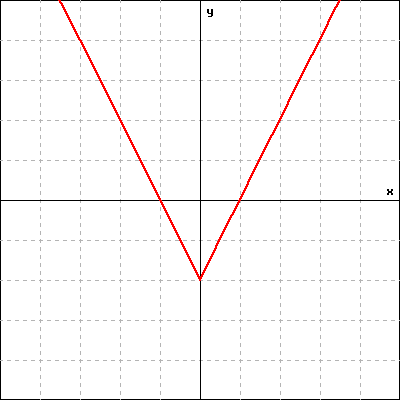
The graph of \(f(x)=x^3 - 3\) is sketched in red and the graph of \(g(x)\) is sketched in blue. Use the translation rule and \(f(x)=x^3 - 3\) to identify the function \(g(x)\text{;}\)
\(g(x)=\)
Answer.
\(-x^{3}-\left(-3\right)\)

16.

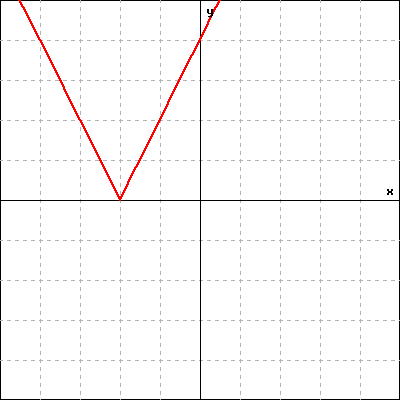
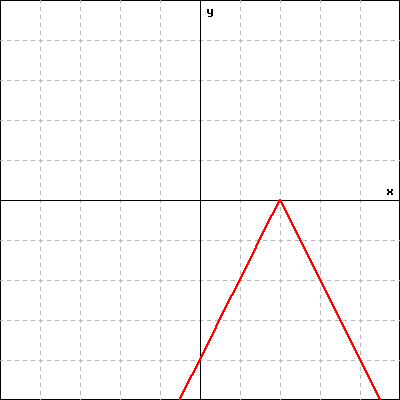
Describe how \(g(x)\) represents a transformation of the function \(f(x)\text{:}\)
Answer 1.
\(\text{vertical stretch ... -axis}\)
Answer 2.
\(\text{horizontal ... axis}\)

17.

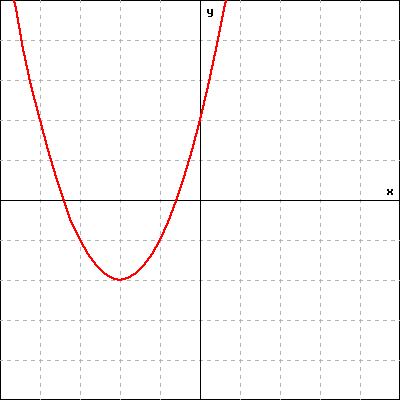
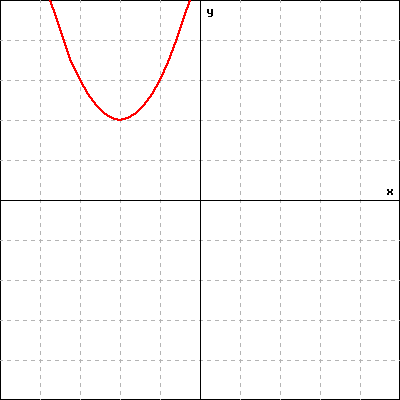
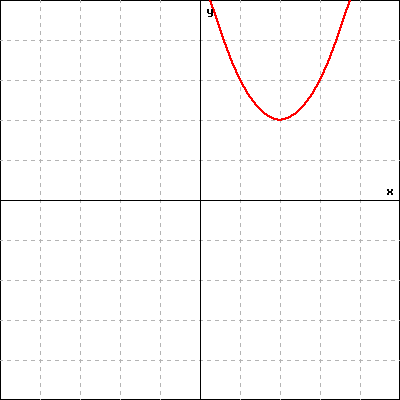
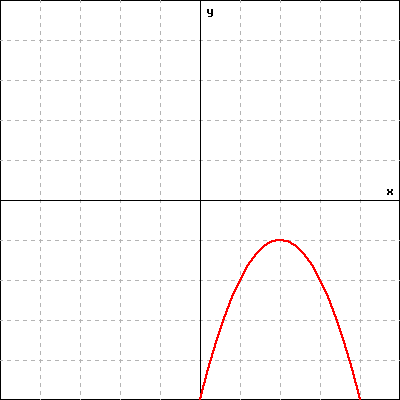
Consider the equation \(y = (x+2)^2+2\text{.}\) By hand without using technology, sketch a graph of this equation on paper.
Which graph A-D below most closely matches the graph you drew?
A B
C D
(Click on a graph to enlarge it.)
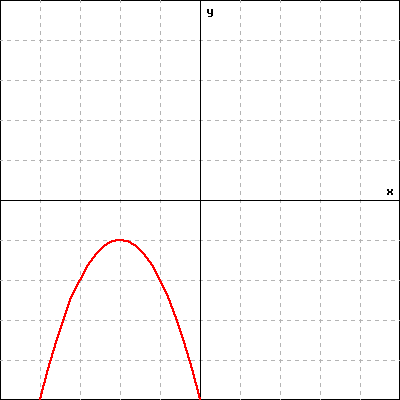
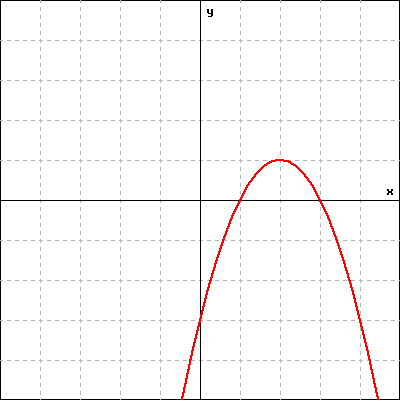
Consider the equation \(y = -(x+2)^2+1\text{.}\) By hand without using technology, sketch a graph of this equation on paper.
Which graph A-D below most closely matches the graph you drew?
A B
C D
(Click on a graph to enlarge it.)
Answer 1.
\(\text{B}\)
Answer 2.
\(\text{D}\)

18.

Suppose \({\left(2,-5\right)}\) is a point on the graph of \(y=f(x)\text{.}\) What is a point that will be on the graph of \(y=3f(x) - 6\text{?}\)
Enter a point as \((a,b)\text{,}\) including the parentheses.
Answer.
\(\left(2,-21\right)\)

19.

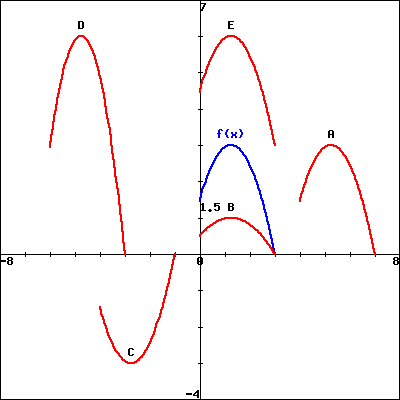
The graph of \(y=f(x)\) is given below (in blue), along with several related graphs (which are in red).
Note: you can click on the graph to enlarge it.
For each equation, enter the letter of the corresponding graph.
\(y= -f(x+4)\)
\(y= f(x)+3\)
\(y= \frac{1}{3} f(x)\)
\(y= 2f(x+6)\)
\(y=f(x-4)\)

20.

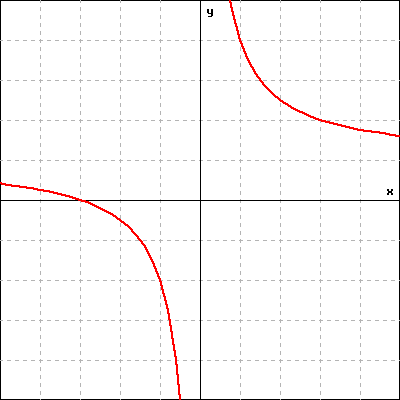
(a) Let the graph of \(f(x)\) be given by:
(Click on graph to enlarge)
Which of the following is the graph of \(y=3 f(x) - 1\text{?}\)
A B
C D
(Click on a graph to enlarge it.)
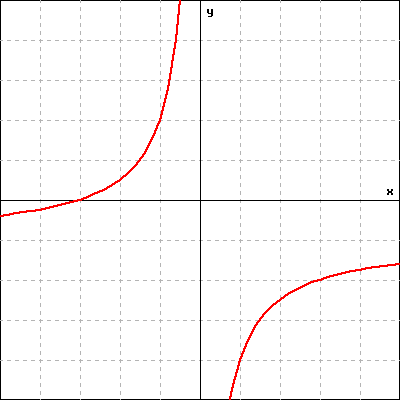
(b) Let the graph of \(g(x)\) be given by:
(Click on graph to enlarge)
Which of the following is the graph of \(y=2 g(x) - 2\text{?}\)
A B
C D
(Click on a graph to enlarge it.)
Answer 1.
\(\text{C}\)
Answer 2.
\(\text{C}\)