Math Trailhead

Worksheet Lines in the Plane

1.

Find a linear equation satisfying the following conditions:
Passes through the points \((-4,-5)\) and \((-7,8)\)
Write your answer using integers or fractions.
\(y =\)\(x +\)
Answer 1.
\(-{\frac{13}{3}}\)
Answer 2.
\(-{\frac{67}{3}}\)
Solution.
We are given two points:
\(x_1 = -4\text{,}\) \(y_1 = -5\text{,}\) \(x_2 = -7\text{,}\) and \(y_2 = 8\text{.}\)
Start by finding the slope:
\(m = \frac{y_2 - y_1}{x_2 - x_1} = \frac{8 + 5}{-7 + 4} = \frac{{13}}{{-3}} = {-{\frac{13}{3}}}\)
Now we can use the point-slope formula to write the equation of this line:
\(y - y_1 = m(x - x_1)\)
\(m = {-{\frac{13}{3}}}\)
\(x_1 = -4\)
\(y_1 = -5\)
\(y + 5 = {-{\frac{13}{3}}}(x + 4)\)
To put the equation in slope-intercept form, distribute -13/3 and then add -5 to both sides.
\({y-\left(-5\right)} = {-{\frac{13}{3}}}x - {-{\frac{13}{3}}} \cdot -4\)
\({y-\left(-5\right)} = {-\left({\frac{13}{3}}\right)x-{\frac{52}{3}}}\)
\(y = {-{\frac{13}{3}}}x + {-{\frac{67}{3}}}\)
Note: To multiply fractions, we multiply straight across. For example \(\frac{2}{5} \cdot 6 = \frac{2}{5} \cdot \frac{6}{1} = \frac{12}{5}\text{.}\)
To add or subtract fractions we need a least common denominator (LCD). For example, \(\frac{2}{5} - 3 = \frac{2}{5} - \frac{3}{1} = \frac{2}{5} - \frac{15}{5} = -\frac{13}{5}\text{.}\)
2.

Find an equation of the line with slope \(\displaystyle{{-{\frac{1}{5}}} }\) that passes through the point \((2,1)\text{.}\) Write your solution in slope-intercept form.
Answer.
\(y = \left(-{\frac{1}{5}}\right)x+\left({\frac{7}{5}}\right)\)
Solution.
When trying to find the equation of a line with some information, start with the equation in slope-intercept form, that is, \(y = mx+b\text{.}\) Then substitute in any known information. In this case, we know the slope is \(m={-{\frac{1}{5}}}\text{,}\) or
\(\displaystyle{ y = {-{\frac{1}{5}}} x + b }\)
Next, substitute in the point \((2,1)\) or
\begin{equation*} \begin{aligned} 1 \amp = ({-{\frac{1}{5}}})(2) + b \\ 1 \amp = {-{\frac{2}{5}}} + b \end{aligned} \end{equation*}
Next, substract \({-{\frac{2}{5}}}\) from both sides:
\begin{equation*} {{\frac{7}{5}}} = b \end{equation*}
and finally plug this value of b into the equation:
\begin{equation*} y = {-{\frac{1}{5}}} x + {{\frac{7}{5}}} \end{equation*}

4.

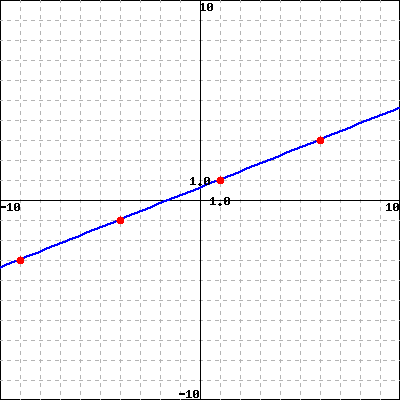
The graph of the function \(y=f(x)\) is given by the line displayed above.
Find \(f(-4)=\)
Find \(f(1)=\)
So, the slope is \(m=\)
Find an equation for the line graphed above:
Hint.
Start by identifying a couple of β€œnice” points on the grid that the line passes through.
Once have two points for your line to pass through, you can determine the slope.
Use the point-slope form of a line. \(y = m (x-x_A) + y_A\)
Answer 1.
Answer 2.
Answer 3.
\({\frac{2}{5}}\)
Answer 4.
\(y = \frac{2}{5}\mathopen{}\left(x+4\right)-1\)
Solution.
The graphed line passes through the points: \(A = (-9,-3)\text{,}\) \(B = (-4,-1)\text{,}\) \(C = (1,1)\)
Select any pair of points on the line to compute the slope:
\(m = \frac{\Delta y}{\Delta x} = \frac{-1 + 3}{-4 + 9} = {{\frac{2}{5}}}\)
Use the point-slope form of a line:
\(y = m (x - x_A) + y_A\)
\(y = {{\frac{2}{5}}\mathopen{}\left(x+4\right)-1}\)

5.

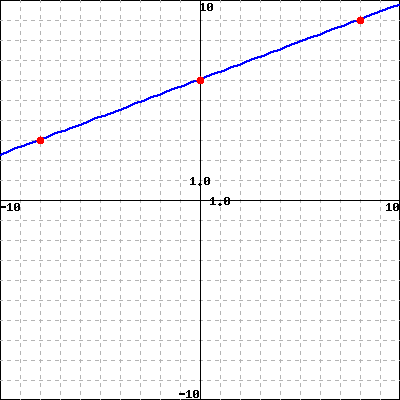
The graph of the function \(y=f(x)\) is given by the line displayed above.
Find \(f(0)=\)
Find \(f(8)=\)
So, the slope is \(m=\)
Find an equation for the line graphed above:
Hint.
Start by identifying a couple of β€œnice” points on the grid that the line passes through.
Once have two points for your line to pass through, you can determine the slope.
Use the point-slope form of a line. \(y = m (x-x_A) + y_A\)
Answer 1.
Answer 2.
Answer 3.
\({\frac{3}{8}}\)
Answer 4.
\(y = \frac{3}{8}x+6\)
Solution.
The graphed line passes through the points: \(A = (-8,3)\text{,}\) \(B = (0,6)\text{,}\) \(C = (8,9)\)
Select any pair of points on the line to compute the slope:
\(m = \frac{\Delta y}{\Delta x} = \frac{6-3}{0 + 8} = {{\frac{3}{8}}}\)
Use the point-slope form of a line:
\(y = m (x - x_A) + y_A\)
\(y = {{\frac{3}{8}}x+6}\)

6.

Find an equation of the line passing through the point \((-2,8)\) that is parallel to the line \(y = {{\frac{4}{5}}x-5}\)
Hint.
You have a point for your line to pass through, all you need is the slope.
What do you know about the slopes of parallel lines?
Use the point-slope form of a line. \(y = m (x-x_A) + y_A\)
Answer.
\(y = \frac{4}{5}\mathopen{}\left(x+2\right)+8\)
Solution.
We’re parallel to the line \(y = {{\frac{4}{5}}x-5}\text{,}\) which has slope \(m = {{\frac{4}{5}}}\text{.}\)
Which means our slope must also be \(m = {{\frac{4}{5}}}\)
\(A = (-2,8)\)
Use the point-slope form of a line:
\(y = m (x - x_A) + y_A\)
\(y = {{\frac{4}{5}}\mathopen{}\left(x+2\right)+8}\)

7.

Find an equation of the line passing through the points \((5,-5)\) with the slope \(m = {{\frac{5}{2}}}\text{.}\)
Hint.
Hint: Use the point-slope form of a line. \(y = m (x-x_A) + y_A\)
Answer.
\(y = \frac{5}{2}\mathopen{}\left(x-5\right)-5\)
Solution.
Use the point-slope form of a line:
\(y = m (x - x_A) + y_A\)
\(y = {{\frac{5}{2}}\mathopen{}\left(x-5\right)-5}\)

8.

A line’s equation is given in point-slope form:
\({y-5}={2\mathopen{}\left(x-1\right)}\)
This line’s slope is .
A point on this line that is apparent from the given equation is .
Answer 1.
Answer 2.
\(\left(1,5\right)\)
Solution.
Compare the given equation with a generic point-slope equation:
\(\begin{aligned} y-y_{1} \amp = m(x-x_{1}) \\ {y-5} \amp = {2\mathopen{}\left(x-1\right)} \end{aligned}\)
We can see the slope is \(2\text{,}\) and an apparent point on the line \((x_{1},y_{1})\) is \({\left(1,5\right)}\text{.}\)

9.

A line’s equation is given in point-slope form:
\({y}={-2\mathopen{}\left(x+2\right)+5}\)
This line’s slope is .
A point on this line that is apparent from the given equation is .
Answer 1.
Answer 2.
\(\left(-2,5\right)\)
Solution.
Compare the given equation with a generic point-slope equation:
\(\begin{aligned} y \amp = m(x-x_{1})+y_1 \\ {y} \amp = {-2\mathopen{}\left(x+2\right)+5} \end{aligned}\)
We can see the slope is \(-2\text{,}\) and an apparent point on the line \((x_{1},y_{1})\) is \({\left(-2,5\right)}\text{.}\)

10.

Find an equation of the line passing through the points \((-3,-8)\) and \((-8,-2)\text{.}\)
Hint.
Use the slope formula:
\(\displaystyle \frac{y_A - y_B}{x_A - x_B}\)
Where your points are \((x_A,y_A)\) and \((x_B,y_B)\text{.}\)
Hint: Use the point-slope form of a line. \(y = m (x-x_A) + y_A\)
Answer.
\(y = \frac{-6}{5}\mathopen{}\left(x+3\right)-8\)
Solution.
First, find the slope by using the slope formula:
\(\displaystyle m = \frac{y_A - y_B}{x_A - x_B}\)
\(\displaystyle m = \frac{-8 + 2}{-3 + 8}\)
\(\displaystyle m = \frac{-6}{5}\)
\(\displaystyle m = {-{\frac{6}{5}}}\)
Then use the point-slope form of a line:
\(y = m (x - x_A) + y_A\)
\(y = {-{\frac{6}{5}}\mathopen{}\left(x+3\right)-8}\)

11.

Find an equation of the line through \((-1,2)\) and \((-4,5)\text{.}\) Write your answer in slope-intercept form.
Answer.
\(y = -x+1\)
Solution.
When trying to find the equation of a line with some information, start with the equation in slope-intercept form, that is, \(y = mx+b\text{.}\) Then substitute in any known information. We know neither the slope or the y-intercept in this case, but easily can find the slope from the two points:
\begin{equation*} m = \frac{2-5}{-1 + 4} = {-1} \end{equation*}
Then substitute this into the slope-intercept form of the line:
\begin{equation*} y = {-1} x + b \end{equation*}
Next, substitute in the point \((-1,2)\) or
\begin{equation*} \begin{aligned} 2 \amp = ({-1})(-1) + b \\ 2 \amp = 1 + b \end{aligned} \end{equation*}
Next, subtract \(1\) from both sides:
\begin{equation*} {1} = b \end{equation*}
and finally plug this value of \(b\) into the equation:
\begin{equation*} {y = -x+1} \end{equation*}

13.

A line has the equation \(\displaystyle{ -{7}x+y= 10 }\text{.}\) Find this line’s slope and \(y\)-intercept. If either of these do not exist, you may enter DNE or NONE.
This line’s slope is .
This line’s \(y\)-intercept is .
Answer 1.
Answer 2.
\(\left(0,10\right)\)
Solution.
When an equation of a line is written in the form \(y=mx+b\text{,}\) it is said to be in slope-intercept form. In this form, \(m\) is the line’s slope, and \(b\) is the coordinate on the \(y\)-axis where the line intercepts the \(y\)-axis.
In this problem, the line’s equation is given as \(\displaystyle{ -{7}x+y= 10 }\text{.}\) It would be helpful to algebraically rearrange this into slope-intercept form: \(y= mx+b\text{.}\)
\(\displaystyle{\begin{aligned} -{7}x+y \amp = 10 \\ -{7}x+y\mathbf{{}+{7}x} \amp = 10\mathbf{{}+{7}x} \\ y \amp = {7}x+10 \end{aligned} }\)
Now we can see the line’s slope is \({7}\text{,}\) and its \(y\)-intercept has coordinates \((0,10)\text{.}\)

15.

On the graph, make the two lines parallel.
The dashed line is given by the equation \(-3x+10y = 30\text{.}\)
What is the slope of the dashed line?
What is the slope of any line parallel to the dashed line?
Find an equation for the parallel line that passes through \(\left(5,-2\right)\text{.}\)
Hint.
The point at \(\left(5,-2\right)\) is not draggable because the problem tells you that your line must pass through \(\left(5,-2\right)\text{.}\)
You only need to drag the second point to a location on the grid that satisfies the necessary slope to make the two lines parallel.
You do not need to graph the \(y\)-intercept for this problem.
Answer 1.
\({\frac{3}{10}}\)
Answer 2.
\({\frac{3}{10}}\)
Answer 3.
\(y+2 = \frac{3}{10}\mathopen{}\left(x-5\right)\)

16.

On the graph, make the two lines parallel.
The dashed line is given by the equation \(y = \frac{1}{6}x-3\text{.}\)
What is the slope of the dashed line?
What is the slope of any line parallel to the dashed line?
Find an equation for the parallel line that passes through \(\left(6,5\right)\text{.}\)
Hint.
The point at \(\left(6,5\right)\) is not draggable because the problem tells you that your line must pass through \(\left(6,5\right)\text{.}\)
You only need to drag the second point to a location on the grid that satisfies the necessary slope to make the two lines parallel.
You do not need to graph the \(y\)-intercept for this problem.
Answer 1.
\({\frac{1}{6}}\)
Answer 2.
\({\frac{1}{6}}\)
Answer 3.
\(y-5 = \frac{1}{6}\mathopen{}\left(x-6\right)\)

17.

On the graph, make the two lines perpendicular.
The dashed line is given by the equation \(9x+4y = 4\text{.}\)
What is the slope of the dashed line?
What slope would make a line perpendicular to the dashed one?
Find an equation for the perpendicular line that passes through \(\left(-5,1\right)\text{.}\)
Hint.
The point at \(\left(-5,1\right)\) is not draggable because the problem tells you that your line must pass through \(\left(-5,1\right)\text{.}\)
You only need to drag the second point to a location on the grid that satisfies the necessary slope to make the two lines perpendicular.
You do not need to graph the \(y\)-intercept for this problem.
Answer 1.
\(-{\frac{9}{4}}\)
Answer 2.
\({\frac{4}{9}}\)
Answer 3.
\(y-1 = \frac{4}{9}\mathopen{}\left(x+5\right)\)

18.

On the graph, make the two lines perpendicular.
The dashed line is given by the equation \(y = 2x+3\text{.}\)
What is the slope of the dashed line?
What slope would make a line perpendicular to the dashed one?
Find an equation for the perpendicular line that passes through \(\left(-3,-3\right)\text{.}\)
Hint.
The point at \(\left(-3,-3\right)\) is not draggable because the problem tells you that your line must pass through \(\left(-3,-3\right)\text{.}\)
You only need to drag the second point to a location on the grid that satisfies the necessary slope to make the two lines perpendicular.
You do not need to graph the \(y\)-intercept for this problem.
Answer 1.
Answer 2.
\(-{\frac{1}{2}}\)
Answer 3.
\(y+3 = \frac{-1}{2}\mathopen{}\left(x+3\right)\)

19.

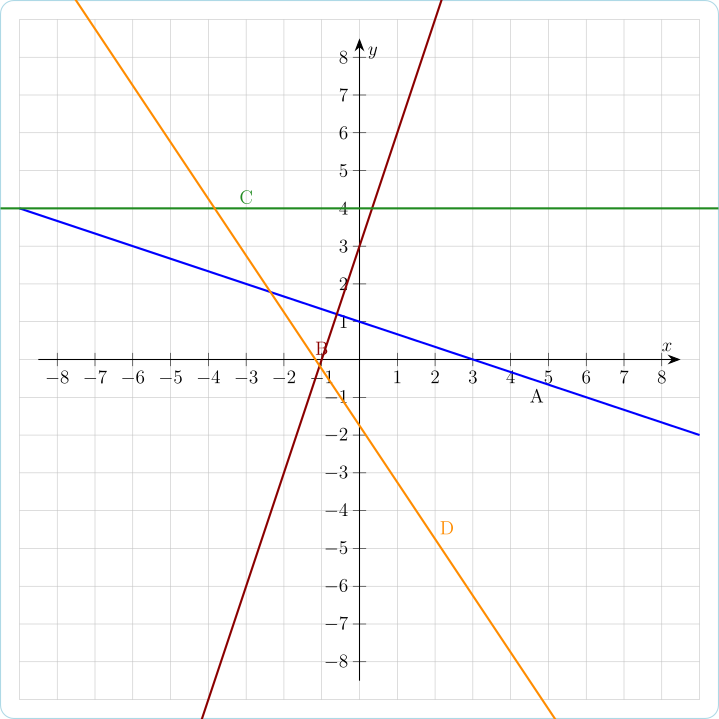
A graph of four lines.  Line A passes through the points (3,0) and (0,1).  Line B has slope 3 and y-intercept 3. Line C is horizontal and has y-intercept of 4.  Line D has intercepts ((-7/6),0) and (0, (-7/4))
Identify the graphs of the lines by letter:
Answer 1.
\(\text{A}\)
Answer 2.
\(\text{C}\)
Answer 3.
\(\text{B}\)
Answer 4.
\(\text{D}\)
Solution.
For each of the lines in the answer, you should identify if the line is vertical, horizontal or oblique.
In this case, the line \({2x+6y = 6}\) is horizontal. The answer is A.
The line \({y-3x = 3}\) in slope-intercept form, and the slope is 3 with y-intercept of 3. It appears that the line has this slope and y-intercept. The answer is C.
For the other two lines, they are nearly in intercept form, so we should do that. The line \({y = 4}\) is:
\begin{equation*} \begin{eqnarray} 2 x + 6 y \amp = 6 \\ \frac{2}{6} x + \frac{6}{6} y \amp = 1 \\ \frac{x}{{3}} + \frac{y}{{1}} \amp = 1 \end{eqnarray} \end{equation*}
so the x-intercept is \({3}\) and the y-intercept is \({1}\text{.}\) The answer is B.
We could just use process of elimination to find the last line, but lets repeat the process above. The last line is
\begin{equation*} \begin{eqnarray} 6 x + 4 y \amp = -7 \\ \frac{6}{-7} x + \frac{4}{-7} y \amp = 1 \\ \frac{x}{{-{\frac{7}{6}}}} + \frac{y}{{-{\frac{7}{4}}}} \amp = 1 \end{eqnarray} \end{equation*}
so the x-intercept is -7/6 and the y-intercept is -7/4. The answer is D.

20.

Consider the graph
graph of a line through ([-1],[1]) and ([-3],[1]).
What is the formula of this line? \(y=\)
Answer.
\(0x+1\)
Solution.
In this case, we need to find the equation of the line based on the graph. It’s generally easiest to find the equation in slope-intercept form, so we will need both the slope and the y-intercept. It hard to just look at the line to get either the slope or the y-intercept, but it appears that there are two points that are easy to see on the graph (since they fall on integer coordinates).
These points appear to be \((-1,1)\) and \((-3,1)\text{,}\) so we will find the line that passes through these points. First, find the slope from the two points:
\(\displaystyle{ m = \frac{1-1}{-1 + 3} = {0} }\)
Then substitute this into the slope-intercept form of the line:
\(\displaystyle{ y = {0} x + b }\)
Next, substitute in the point \((-1,1)\) or
\(\displaystyle{\begin{aligned} 1 \amp = ({0})(-1) + b \\ 1 \amp = + b \end{aligned} }\)
Next, substract \(\) from both sides:
\(\displaystyle{ {1} = b}\) and finally plug this value of b into the equation:
\(\displaystyle{ y = {1} }\)

21.

The equation below shows the profit \(p\) from selling \(n\) cups of lemonade
\(p=2n-10\)
Whice of the following best describes the relationship between \(n\) and \(p\)
Solution.
Solution
The best way to handle this problem, if the answer is not immediately clear to you,
is to add a positive quantity to \(n\) and see what happens to \(p\text{.}\)
Suppose \(m\) is positive and we repace \(n\) by \(n+m\text{.}\) Calling the resulting value
of \(p\) by the name \(p'\) we obtain the equation
\(p'=2(n+m)-10=2n-10+2m\text{.}\)
This tells us that when we increase \(n\) by \(m\) we increase \(p\) by \(2m\text{.}\)