Print preview
Worksheet Sine and Cosine
2.
Use the trigonometric function \(f(x) = 3\sin(x)\) to answer the following questions.
What is the amplitude of \(f(x)\text{?}\)
What the period of \(f(x)\text{?}\)
What is the maximum value of \(f(x)\text{?}\)
What is the minimum value of \(f(x)\text{?}\)
3.
Use the trigonometric function \(f(x) = -4\sin({{\frac{1}{3}}}x)\) to answer the following questions.
What is the amplitude of \(f(x)\text{?}\)
What is the period of \(f(x)\text{?}\)
What is the maximum value of \(f(x)\text{?}\)
What is the minimum value of \(f(x)\text{?}\)
4.
Use the trigonometric function \(f(t) = -6\sin\left(t-\displaystyle\frac{4\pi}{8}\right)\) to answer the following questions.
What is the amplitude of \(f(t)\text{?}\)
What is the period of \(f(t)\) ?
What is the maximum value of \(f(t)\) ?
What is the minimum value of \(f(t)\text{?}\)
If the video does not work, click here to watch on YouTube.
5.
Use the trigonometric function \(f(t) = -\cos\left(t+\displaystyle\frac{\pi}{6}\right)+1\) to answer the following questions.
What is the amplitude of \(f(t)\text{?}\)
What is the period of \(f(t)\) ?
What is the maximum value of \(f(t)\) ?
What is the minimum value of \(f(t)\text{?}\)
6.
Use the trigonometric function \(f(x) = 6\sin\left(\displaystyle\frac{\pi}{3}(x-3)\right)+2\) to answer the following questions.
What is the amplitude of \(f(x)\text{?}\)
What is the period of \(f(x)\text{?}\)
What is the maximum value of \(f(x)\text{?}\)
What is the minimum value of \(f(x)\) ?
7.
The equation \(P=20\sin(2\pi t)+140\) models blood pressure, \(P\text{,}\) where \(t\) represents time in seconds. Find the blood pressure after \(28\) seconds. Also, give the maximum and minimum blood pressures.
8.
9.
10.
\(\displaystyle{ y = {-5\cos\mathopen{}\left(2x\right)} }\)
What is the amplitude of the given function?
What is the period of the given function?
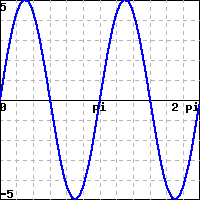 |
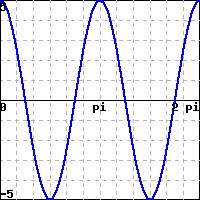 |
| A | B |
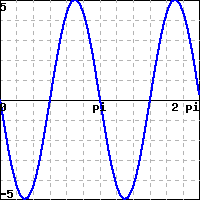 |
|
| C | D |
Hint.
11.
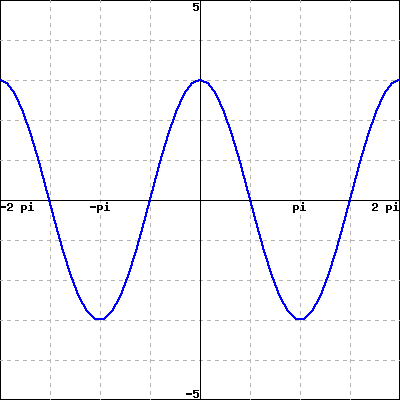
What is the amplitude of the graphed function?
State the formula for the function that is graphed above. \(y =\)
Hint.
Do you recall the difference between the graphs of sine and cosine?\(\sin(x)\) passes through the origin, and \(\cos(x)\) does not.
Amplitude is used to describe the height of the wave.How high does this wave get?
Remember that the formula for a sine or cosine wave looks like:\(y = A \sin(x)\) or \(y = A \cos(x)\)
where \(A\) represents the amplitude.
12.
Practice
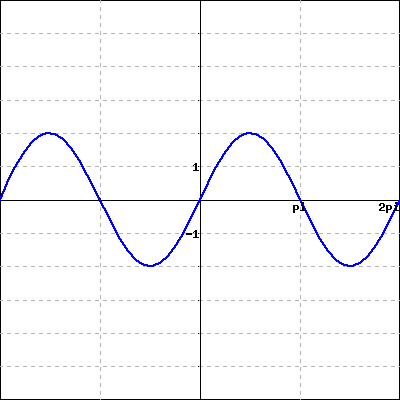
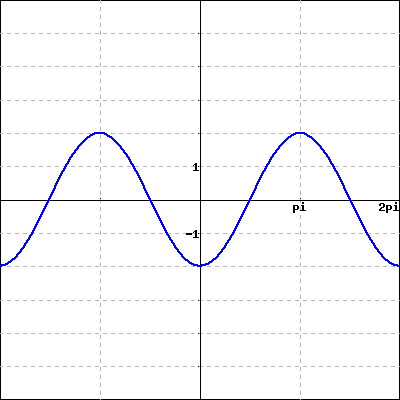
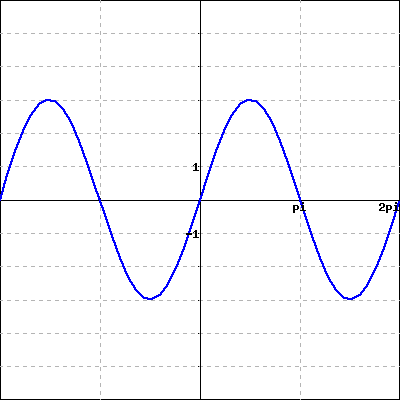
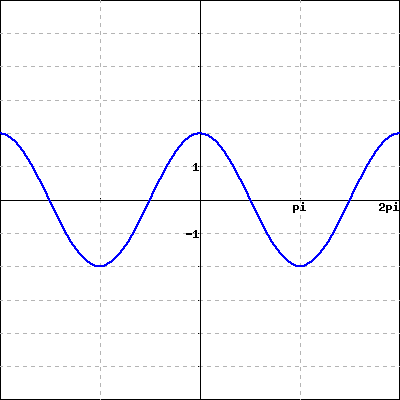
Match the equations given below with their corresponding graphs:
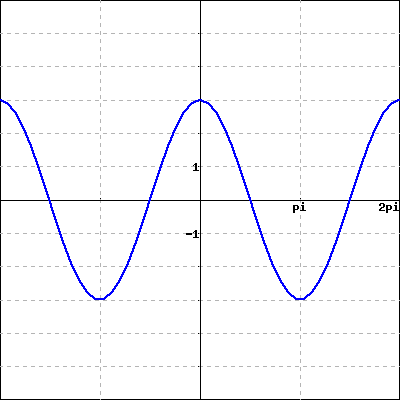
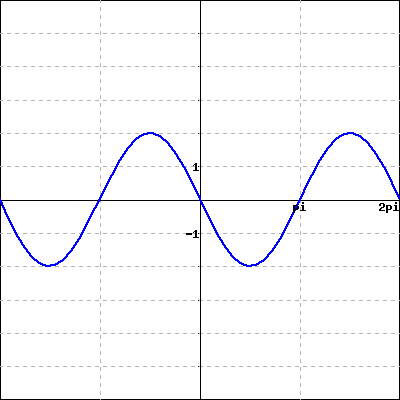
Solution.
-
\(y = {3\sin\mathopen{}\left(x\right)}\) is the graph of sine with positive coefficient and amplitude 3; this corresponds to graph C.
-
\(y = {-2\sin\mathopen{}\left(x\right)}\) is the graph of sine with negative coefficient (so it is the vertically-reflected, or ’upside-down’, version of sine) and amplitude 2; this corresponds to graph F.
-
\(y = {2\cos\mathopen{}\left(x\right)}\) is the graph of cosine with positive coefficient and amplitude 2; this corresponds to graph D.
-
\(y = {2\sin\mathopen{}\left(x\right)}\) is the graph of sine with positive coefficient and amplitude 2; this corresponds to graph A.
13.
Practice
Match the equations given below with their corresponding graphs:
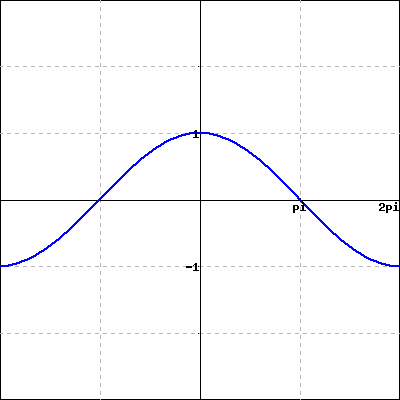
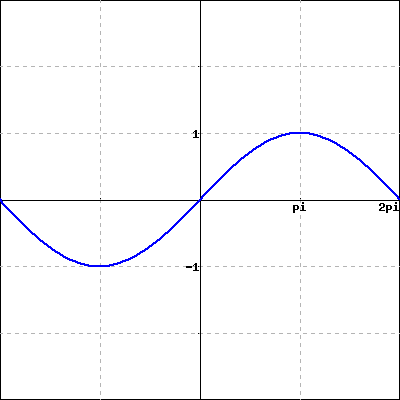
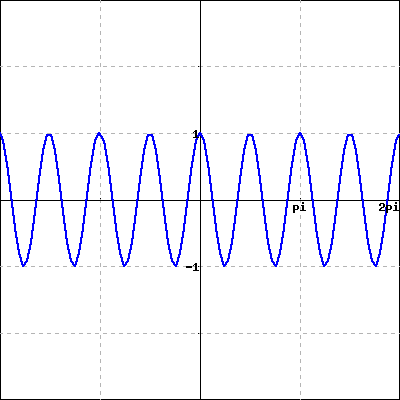
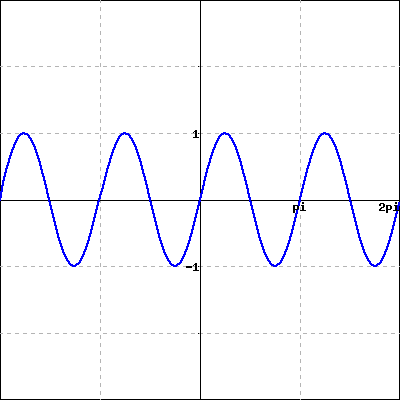
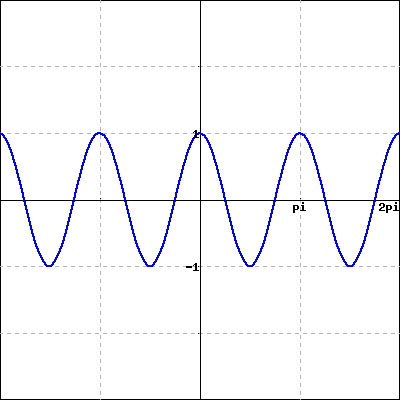
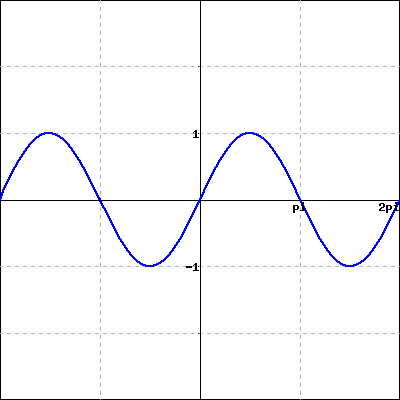
Solution.
-
\(y = {\cos\mathopen{}\left(2x\right)}\) is the graph of \(\cos(\theta)\) with \(\theta = {2x}\text{;}\)A complete oscillation (period) for cosine happens at \(\theta = 2\pi\text{,}\) which corresponds to \({2x} = 2\pi\) (or \(x = {\pi }\));With a period of \({\pi }\text{,}\) we get \({2}\) oscillations between \(0\) and \(2\pi\text{;}\) this corresponds to graph E.
-
\(y = {\sin\mathopen{}\left(\frac{x}{2}\right)}\) is the graph of \(\sin(\theta)\) with \(\theta = {\frac{x}{2}}\text{;}\)A complete oscillation (period) for sine happens at \(\theta = 2\pi\text{,}\) which corresponds to \({\frac{x}{2}} = 2\pi\) (or \(x = {4\pi }\));With a period of \({4\pi }\text{,}\) we get \({\frac{1}{2}}\) an oscillation between \(0\) and \(2\pi\text{;}\) this corresponds to graph B.
-
\(y = {\sin\mathopen{}\left(x\right)}\) is the graph of \(\sin(\theta)\) with \(\theta = {x}\text{;}\)A complete oscillation (period) for sine happens at \(\theta = 2\pi\text{,}\) which corresponds to \({x} = 2\pi\) (or \(x = {2\pi }\));With a period of \({2\pi }\text{,}\) we get \({1}\) oscillation between \(0\) and \(2\pi\text{;}\) this corresponds to graph F.
-
\(y = {\sin\mathopen{}\left(2x\right)}\) is the graph of \(\sin(\theta)\) with \(\theta = {2x}\text{;}\)A complete oscillation (period) for sine happens at \(\theta = 2\pi\text{,}\) which corresponds to \({2x} = 2\pi\) (or \(x = {\pi }\));With a period of \({\pi }\text{,}\) we get \({2}\) oscillations between \(0\) and \(2\pi\text{;}\) this corresponds to graph D.
14.
Practice
Enter an equation for each graph:
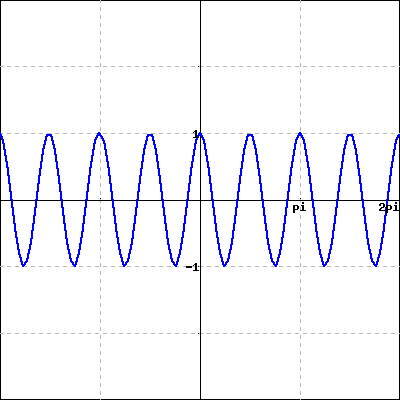
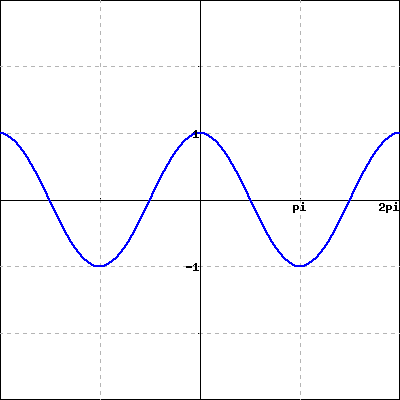
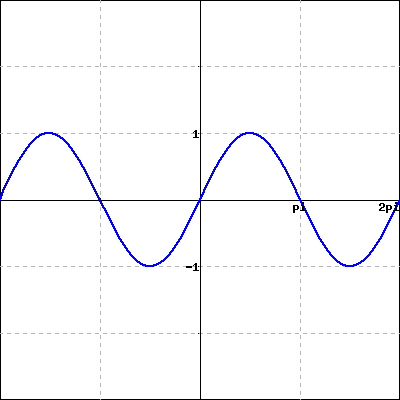
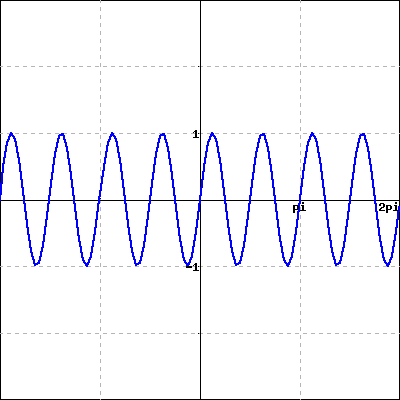
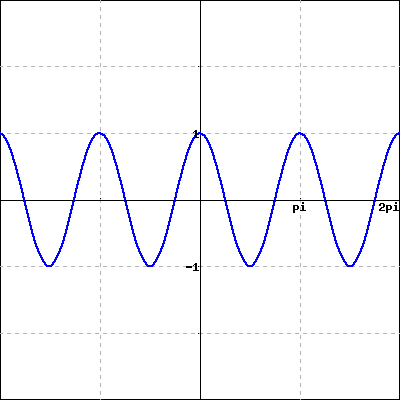
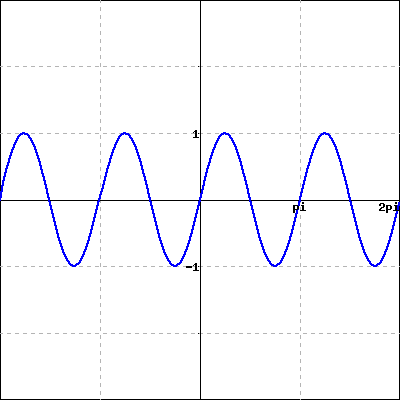
Solution.
-
In order to write an equation for \(\sin(Bx)\) with period \({\pi }\text{,}\) we need to use the fact that \(\sin(Bx)\) has period \(\frac{2\pi}{B}\text{.}\)If \(\frac{2\pi}{B}\) is going to be equal to \({\pi }\text{,}\) that means we need to have \(B = {2}\text{,}\) giving us \(y = {\cos\mathopen{}\left(4x\right)}\) as the equation for this graph.
-
In order to write an equation for \(\cos(Bx)\) with period \({\pi }\text{,}\) we need to use the fact that \(\cos(Bx)\) has period \(\frac{2\pi}{B}\text{.}\)If \(\frac{2\pi}{B}\) is going to be equal to \({\pi }\text{,}\) that means we need to have \(B = {2}\text{,}\) giving us \(y = {\cos\mathopen{}\left(x\right)}\) as the equation for this graph.
-
This means that each period has length \(\frac{2\pi}{{4}}\text{,}\) or \({\frac{\pi }{2}}\text{.}\)In order to write an equation for \(\cos(Bx)\) with period \({\frac{\pi }{2}}\text{,}\) we need to use the fact that \(\cos(Bx)\) has period \(\frac{2\pi}{B}\text{.}\)If \(\frac{2\pi}{B}\) is going to be equal to \({\frac{\pi }{2}}\text{,}\) that means we need to have \(B = {4}\text{,}\) giving us \(y = {\sin\mathopen{}\left(x\right)}\) as the equation for this graph.
-
This means that each period has length \(\frac{2\pi}{{4}}\text{,}\) or \({\frac{\pi }{2}}\text{.}\)In order to write an equation for \(\sin(Bx)\) with period \({\frac{\pi }{2}}\text{,}\) we need to use the fact that \(\sin(Bx)\) has period \(\frac{2\pi}{B}\text{.}\)If \(\frac{2\pi}{B}\) is going to be equal to \({\frac{\pi }{2}}\text{,}\) that means we need to have \(B = {4}\text{,}\) giving us \(y = {\sin\mathopen{}\left(4x\right)}\) as the equation for this graph.
-
In order to write an equation for \(\cos(Bx)\) with period \({2\pi }\text{,}\) we need to use the fact that \(\cos(Bx)\) has period \(\frac{2\pi}{B}\text{.}\)If \(\frac{2\pi}{B}\) is going to be equal to \({2\pi }\text{,}\) that means we need to have \(B = {1}\text{,}\) giving us \(y = {\cos\mathopen{}\left(2x\right)}\) as the equation for this graph.
-
In order to write an equation for \(\sin(Bx)\) with period \({2\pi }\text{,}\) we need to use the fact that \(\sin(Bx)\) has period \(\frac{2\pi}{B}\text{.}\)If \(\frac{2\pi}{B}\) is going to be equal to \({2\pi }\text{,}\) that means we need to have \(B = {1}\text{,}\) giving us \(y = {\sin\mathopen{}\left(2x\right)}\) as the equation for this graph.
15.
Practice
Enter an equation for each graph:
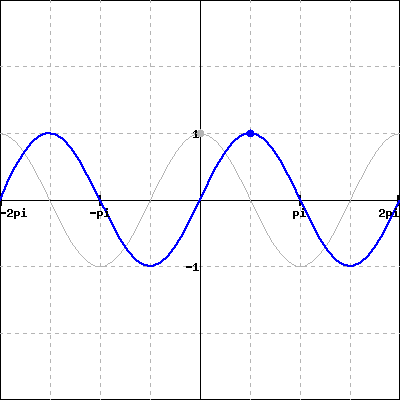
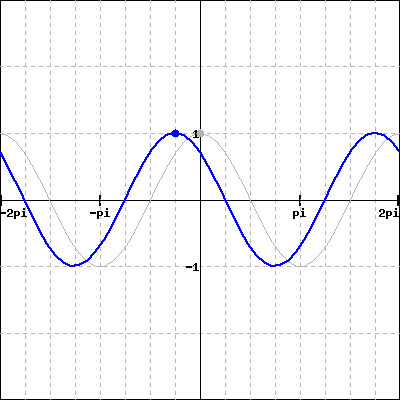
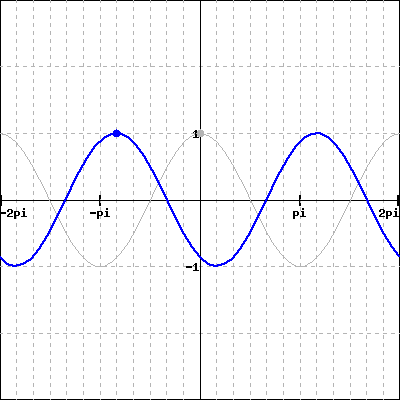
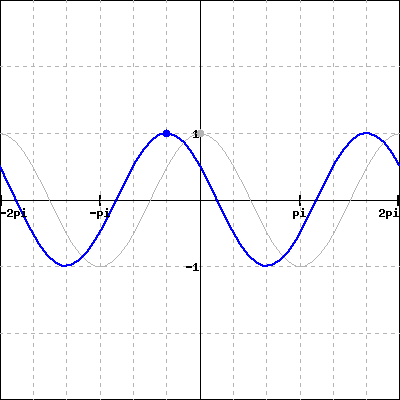
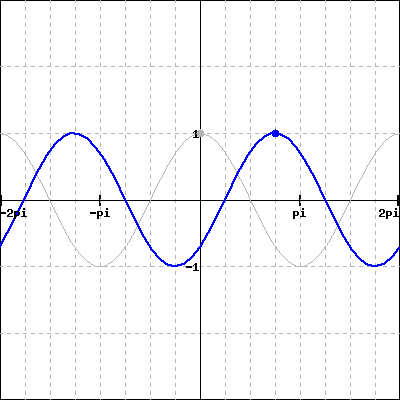
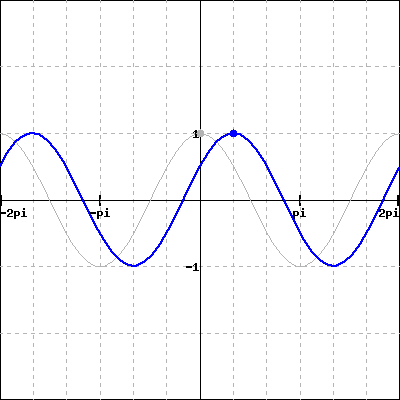
Solution.
-
Graph A is a cosine wave that has been shifted to the right;Looking at the grid lines, we see that the interval between 0 and \(\pi\) has been split into halves, and our graph has been shifted right by one of those halves.If we want an equation for the cosine wave that has been shifted right by one-halves of \(\pi\text{,}\) we need to take \(y = \cos(x)\) and replace \(x\) by \(\left( {x-\frac{\pi }{2}} \right)\text{.}\)Therefore, our equation for Graph A is \(y = {\cos\mathopen{}\left(x-\frac{\pi }{2}\right)}\text{.}\)
-
Graph B is a cosine wave that has been shifted to the left;Looking at the grid lines, we see that the interval between 0 and \(\pi\) has been split into quarters, and our graph has been shifted left by one of those quarters.If we want an equation for the cosine wave that has been shifted left by one-quarters of \(\pi\text{,}\) we need to take \(y = \cos(x)\) and replace \(x\) by \(\left( {x+\frac{\pi }{4}} \right)\text{.}\)Therefore, our equation for Graph B is \(y = {\cos\mathopen{}\left(x+\frac{\pi }{4}\right)}\text{.}\)
-
Graph C is a cosine wave that has been shifted to the left;Looking at the grid lines, we see that the interval between 0 and \(\pi\) has been split into sixths, and our graph has been shifted left by five of those sixths.If we want an equation for the cosine wave that has been shifted left by five-sixths of \(\pi\text{,}\) we need to take \(y = \cos(x)\) and replace \(x\) by \(\left( {x+\frac{5\pi }{6}} \right)\text{.}\)Therefore, our equation for Graph C is \(y = {\cos\mathopen{}\left(x+\frac{5\pi }{6}\right)}\text{.}\)
-
Graph D is a cosine wave that has been shifted to the left;Looking at the grid lines, we see that the interval between 0 and \(\pi\) has been split into thirds, and our graph has been shifted left by one of those thirds.If we want an equation for the cosine wave that has been shifted left by one-thirds of \(\pi\text{,}\) we need to take \(y = \cos(x)\) and replace \(x\) by \(\left( {x+\frac{\pi }{3}} \right)\text{.}\)Therefore, our equation for Graph D is \(y = {\cos\mathopen{}\left(x+\frac{\pi }{3}\right)}\text{.}\)
-
Graph E is a cosine wave that has been shifted to the right;Looking at the grid lines, we see that the interval between 0 and \(\pi\) has been split into quarters, and our graph has been shifted right by three of those quarters.If we want an equation for the cosine wave that has been shifted right by three-quarters of \(\pi\text{,}\) we need to take \(y = \cos(x)\) and replace \(x\) by \(\left( {x-\frac{3\pi }{4}} \right)\text{.}\)Therefore, our equation for Graph E is \(y = {\cos\mathopen{}\left(x-\frac{3\pi }{4}\right)}\text{.}\)
-
Graph F is a cosine wave that has been shifted to the right;Looking at the grid lines, we see that the interval between 0 and \(\pi\) has been split into thirds, and our graph has been shifted right by one of those thirds.If we want an equation for the cosine wave that has been shifted right by one-thirds of \(\pi\text{,}\) we need to take \(y = \cos(x)\) and replace \(x\) by \(\left( {x-\frac{\pi }{3}} \right)\text{.}\)Therefore, our equation for Graph F is \(y = {\cos\mathopen{}\left(x-\frac{\pi }{3}\right)}\text{.}\)
16.
17.
The table below gives the height \(h=f(t)\) in feet of a weight on a spring where \(t\) is time in seconds.
| \(t\) (sec) | 0 | 2 | 4 | 6 | 8 | 10 | 12 | 14 | 16 | 18 | 20 | 22 | 24 | 26 | 28 | 30 |
| \(h\) (feet) | 4.2 | 3 | 2 | 1.8 | 2 | 3 | 4.2 | 5.4 | 6.4 | 6.6 | 6.4 | 5.4 | 4.2 | 3 | 2 | 1.8 |
(a) What is the period of \(\ f(t)\text{?}\) (include )
(b) What is the the midline of \(\ f(t)\text{?}\) (include )
(c) What is the the amplitude of \(\ f(t)\text{?}\) (include )
18.
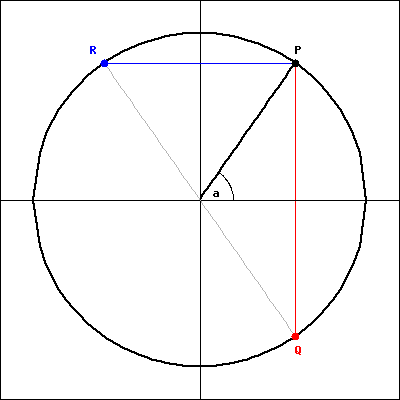
(a) Find another angle \(\phi\) between \(0^\circ\) and \(360^\circ\) that has the same cosine as \(55^{\circ}\text{.}\) (That is, find \(\phi\) satisfying \(\cos(\phi) = \cos(55^\circ)\text{.}\))
\(\phi =\) degrees.
(b) Find another angle \(\phi\) between \(0^\circ\) and \(360^\circ\) that has the same sine as \(55^{\circ}\text{.}\) (That is, find \(\phi\) satisfying \(\sin(\phi) = \sin(55^\circ)\text{.}\))
\(\phi =\) degrees.
19.
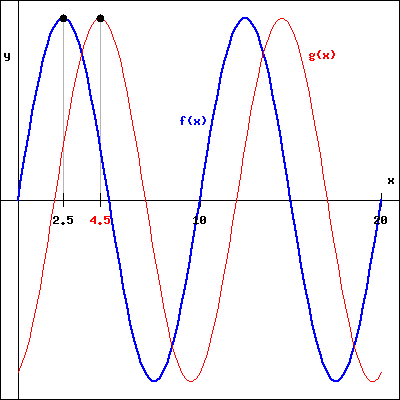
Below is the graph of the function \(f(x) = 10 \sin{ \left( \frac{\pi}{5} x \right)}\) in blue, and a second sinusoidal function \(y = g(x)\) in red, which is a horizontal shift of \(y = f(x)\text{.}\) Find a formula for the function \(g(x)\text{.}\)
\(g(x) =\)
(Click on graph to enlarge)
Solution.
SOLUTION\(\frac{ 2 }{10}\)\(\phi = (2 \pi ) \cdot \left( \frac{ 2 }{10} \right) = \frac{2 \pi}{5}\text{.}\)\(g(x)\)
\begin{equation*}
g(x) = 10 \sin{ \left( \frac{\pi}{5} \ x - \phi \right) } = 10 \sin{ \left( \frac{\pi}{5} \ x - \frac{2 \pi}{5} \right) }.
\end{equation*}
20.
Find a possible formula for the trigonometric function whose values are in the following table (note the values in the table may be slightly rounded):
| \(x\) | 0.00 | 0.25 | 0.50 | 0.75 | 1.00 | 1.25 | 1.50 | 1.75 | 2.00 | 2.25 | 2.50 | 2.75 | 3.00 |
| \(g(x)\) | 4.00 | 5.00 | 5.73 | 6.00 | 5.73 | 5.00 | 4.00 | 3.00 | 2.27 | 2.00 | 2.27 | 3.00 | 4.00 |
\(g(x) =\)
Solution.
SOLUTION\(g(x)\)\(x = 0\)\(g(x)=A \sin{(Bx)}+k\text{,}\)\(A\)\(k\)\(\frac{2 \pi}{B}\text{.}\)\(k \approx 4.00\text{.}\)\(A = \mbox{max} - k = 6.00 - 4.00 = 2\text{.}\)\(\mbox{period} = 3 = \frac{2 \pi}{B}\text{,}\)\(B = \frac{ 2 \pi}{3}\text{.}\)\(g(x) = 2 \sin{\left( \frac{2 \pi}{3} x \right)}+4\text{.}\)

