
Math Trailhead

Worksheet Modeling

1.

The function \(C\) models the number of customers that are in a store \(t\) hours after the store opened on a certain day.
\(t\) \(0\) \(1\) \(2\) \(3\) \(4\) \(5\) \(6\) \(7\) \(8\) \(9\) \(10\) \(11\) \(12\)
\(C(t)\) \(0\) \(26\) \(47\) \(70\) \(88\) \(98\) \(100\) \(97\) \(86\) \(70\) \(55\) \(26\) \(0\)
  1. \(C(7)=\)
  2. Interpret the meaning of \(C(7)\text{:}\)
    1. In \(7\) hours since the store opened, there were a total of \(97\) customers.
    2. In \(7\) hours since the store opened, the store had an average of \(97\) customers per hour.
    3. There were \(97\) customers in the store \(7\) hours after the store opened.
    4. There were \(7\) customers in the store \(97\) hours after the store opened.
  3. Solve \(C(t)=70\) for \(t\text{.}\) \(t=\)
  4. Interpret the meaning of Part c’s solution(s):
    1. There were \(70\) customers in the store \(3\) hours after the store opened.
    2. There were \(70\) customers in the store \(3\) hours after the store opened, and again \(9\) hours after the store opened.
    3. There were \(70\) customers in the store \(9\) hours after the store opened.
    4. There were \(70\) customers in the store either \(3\) hours after the store opened, or \(9\) hours after the store opened.
Hint.
What is the meaning of \(t\text{?}\) What are the units of \(t\text{?}\)
What is the meaning of \(C(t)\text{?}\) What are the units of \(C(t)\text{?}\)
Answer 1.
Answer 2.
\(\text{C}\)
Answer 3.
\(3, 9\)
Answer 4.
\(\text{B}\)
Solution.
  1. According to data in the table, \(C(7)=97\text{.}\)
  2. Answer is that there were \(97\) customers in the store \(7\) hours after the store opened.
  3. According to data in the table, \(C(3)=70\) and \(C(9)=70\text{.}\) So the answer is \({3, 9}\text{.}\)
  4. Answer is that there were \(70\) customers in the store \(3\) hours after the store opened, and again \(9\) hours after the store opened.


2.

Morah started saving in a piggy bank on her birthday. The function \(f(x)={2x+2}\) models the amount of money, in dollars, in Morah’s piggy bank. The independent variable represents the number of days passed since her birthday.
Interpret the meaning of \(f(5)=12\text{.}\)
  1. A. Five days after Morah started her piggy bank, there were `$12` in it.
  2. B. The piggy bank started with `$12` in it, and Morah saves `$5` each day.
  3. C. The piggy bank started with `$5` in it, and Morah saves `$12` each day.
  4. D. Twelve days after Morah started her piggy bank, there were `$5` in it.
Hint.
For \(f(x)={2x+2}\text{,}\) what does the value of \(x\) respresent?
What does the value of \(f(x)\) represent?
What are the units of \(x\text{?}\)
What are the units of \(f(x)\text{?}\)
Answer.
\(\text{A}\)
Solution.
For \(f(x)={2x+2}\text{,}\) the value of \(x\) represents the number of days passed since Morah’s birthday, and the value of \(f(x)\) represents the amount of money in the piggy bank.
It’s helpful to understand those values by units: \(x\) is in β€œdays,” while \(f(x)\) is in β€œdollars.”
For \(f(5)=12\text{,}\) \(5\) represents \(5\) days, while \(12\) represents \(12\) dollars. The correct solution is: A. Five days after Morah started her piggy bank, there were `$12` in it.

3.

An arcade sells multi-day passes. The function \(g(x)={\left({\frac{1}{4}}\right)x}\) models the number of days a pass will work, where \(x\) is the amount of money paid, in dollars.
Interpret the meaning of \(g(16)={4}\text{.}\)
  1. A. Each pass costs `$4`, and it works for `16` days.
  2. B. If a pass costs `$4`, it will work for `16` days.
  3. C. Each pass costs `$16`, and it works for `4` days.
  4. D. If a pass costs `$16`, it will work for `4` days.
Hint.
For \(g(x)={\left({\frac{1}{4}}\right)x}\text{,}\) what does the value of \(x\) respresent?
What does the value of \(g(x)\) represent?
What are the units of \(x\text{?}\)
What are the units of \(f(x)\text{?}\)
Answer.
\(\text{D}\)
Solution.
For \(g(x)={\left({\frac{1}{4}}\right)x}\text{,}\) the value of \(x\) represents the cost of a pass, and the value of \(g(x)\) represents the number of days the pass will work.
It’s helpful to understand those values by units: \(x\) is in β€œdollars,” while \(g(x)\) is in β€œdays.”
For \(g(16)={4}\text{,}\) \(16\) represents \(16\) dollars, while \({4}\) represents \({4}\) days. The correct solution is: D. If a pass costs `$16`, it will work for `4` days.

4.

Randi will spend \({\$180}\) to purchase some bowls and some plates. Each bowl costs \({\$5}\text{,}\) and each plate costs \({\$6}\text{.}\) The function \(p(b)={-\left({\frac{5}{6}}\right)b+30}\) models the number of plates Randi to be purchased, where \(b\) represents the number of bowls to be purchased.
Interpret the meaning of \(p(24)={10}\text{.}\)
  1. A. `$10` will be used to purchase bowls, and `$24` will be used to purchase plates.
  2. B. `10` bowls and `24` plates can be purchased.
  3. C. `$24` will be used to purchase bowls, and `$10` will be used to purchase plates.
  4. D. `24` bowls and `10` plates can be purchased.
Hint.
For \(p(b)={-\left({\frac{5}{6}}\right)b+30}\text{,}\) what does the value of \(b\) respresent?
What does the value of \(p(b)\) represent?
Answer.
\(\text{D}\)
Solution.
For \(p(b)={-\left({\frac{5}{6}}\right)b+30}\text{,}\) the value of \(b\) represents the number of bowls to be purchased, and the value of \(p(b)\) represents the number of plates to be purchased.
For \(p(24)={10}\text{,}\) \(24\) implies \(24\) bowls will be purchased, while \({10}\) implies \({10}\) plates will be purchased. The correct solution is D. `24` bowls and `10` plates can be purchased.

5.

According to the 1993 World Almanac, the number of calories a person walking at 3 mph, bicycling at 10 mph, or swimming at 2 mph burns per minute depends on the person’s weight as in the following table.
Calories per minute as a function of weight
Weight (pounds) 100 120 150 170 200 220
Walking (calories) 2.7 3.2 4.0 4.6 5.4 5.9
Bicycling (calories) 5.4 6.5 8.1 9.2 10.8 11.9
Swimming (calories) 5.8 6.9 8.7 9.8 11.6 12.7
(a) Use the table to determine the number of calories that a person weighing 100 pounds uses in a half-hour of walking.
(b) The table illustrates a relationship between the number of calories used per minute walking and a person’s weight in pounds.
Identify the independent variable(s)
Identify the dependent variable(s)
Answer.
Solution.
SOLUTION\(30(2.7) = 81\)

6.

The table below gives the total cost, \(f(n)\text{,}\) for a carpenter to build \(n\) wooden chairs.
\(n\) 0 5 10 15 20 25
\(f(n)\) 6000 7000 7850 8500 9000 9300
Evaluate each of the expressions below:
(a) \(f( 20 ) =\)
(b) \(f( x ) =\) if \(x = 10\)
(c) \(z =\) if \(f(z) = 8500\)
(d) \(f( 0 ) =\)
For each of the statements below decide which (if any) expression (a)-(d) above it correctly describes by selecting the appropriate letter in each pull-down menu. An expression may be described correctly by more than one statement, and some statements may not match any of the expressions.
(e) The total number of chairs that can be built at a cost of $20.
.
(f) The total number of chairs that can be built at a cost of $8500.
.
(g) The cost of building 20 chairs.
.
(h) The cost of building 10 chairs.
.
(i) The total number of chairs the carpenter must build in order to break even.
.
(j) The fixed costs of the carpenter.
.
Answer 1.
\(9000\)
Answer 2.
\(7850\)
Answer 3.
Answer 4.
\(6000\)
Answer 5.
\(\text{None of the above}\)
Answer 6.
\(\text{(c)}\)
Answer 7.
\(\text{(a)}\)
Answer 8.
\(\text{(b)}\)
Answer 9.
\(\text{None of the above}\)
Answer 10.
\(\text{(d)}\)
Solution.
SOLUTION\(f( 20 ) = 9000\text{.}\)\(f( x ) = 7850\)\(x = 10\)\(z = 15\)\(f(z) = 8500\)\(f( 0 ) = 6000\)\(f( 20 ) = 9000\)\(f( 10 ) = 7850\text{,}\)\(f(z) = 8500\)\(z = 15\text{,}\)\(f(0) = 6000\)

7.

A national park records data regarding the total fox population in the park over a twelve month period. Let \(F(t)\) represent the number of foxes in the park \(t\) months after they start recording the fox population. Below is a table that records their results.
\(t\) (months) 0 1 2 3 4 5 6 7 8 9 10 11
\(F(t)\) (foxes) 150 143 125 100 75 57 50 57 75 100 125 143
(a) Is \(F\) a function of \(t\text{?}\)
(b) Find all solution(s) to the equation \(F(t) = 100\text{.}\) If there is more than one solution, give your answer as a comma separated list of numbers.
\(t =\)
Answer.
Solution.
SOLUTION\(t\)\(F\text{.}\)\(F(t) = 100\)\(t=3\)\(t=9\)

8.

The value, \(V\text{,}\) of a car that is \(t\) years old is given by \(V = f(t) = 16000 - 2700 t\text{.}\) What is the largest domain of \(f(t)\) that make sense in this context? How about range?
Domain:
Range:
Hint: When using inequalities, check that the variables you use match the ones the question uses.
Answer 1.
\(0\le t\le \frac{16000}{2700}\)
Answer 2.
\(0\le V\le 16000\)

9.

A movie theater is filled to capacity with \(450\) people. After the movie ends, people start leaving at the rate of \(100\) each minute.
(a) Find an equation for \(N\text{,}\) the number of people in the theater, as a function of \(t\text{,}\) the number of minutes after the movie ends. Enter your answer as an equation, such as \(N = 5t-1\text{.}\)
(b) For what values of \(t\) does the equation make sense in practical terms.
Domain:
Answer 1.
\(N = 450-100t\)
Answer 2.
\(0\le t\le \frac{450}{100}\)

10.

Let \(f(t)\) give the number of liters of fuel oil burned in \(t\) hours, and \(g(t)\) the number of gallons burned. Find a formula for \(g\) by scaling the output of \(f\text{.}\) Use the fact that 1 gallon equals 3.785 liters. You may enter the function \(f(t)\) verbatim, as you would for any other named function.
\(g(t)\) = gallons
Answer.
\(\frac{f\mathopen{}\left(t\right)}{3.785}\)

11.

At the end of a semester, students’ math grades are listed in a table which gives each student’s ID number in the left column and the student’s grade in the right column. Let \(N\) represent the ID number and \(G\) represent the grade of each student.
Which of the following statements regarding the relationship between student ID number and grade is true?
Solution.
SOLUTION\(N\)\(G\)\(G\)\(N\text{.}\)\(G\)\(N\text{.}\)\(N\)\(G\text{,}\)\(N\)\(G\text{.}\)\(N\)\(G\text{.}\)

12.

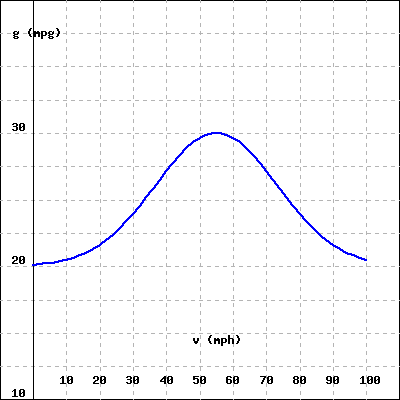
The graph below shows the fuel consumption (in miles per gallon, mpg) of a car driving at various speeds (in miles per hour, mph).
(click on image to enlarge)
(a) How much gas is used on a 600 mile trip at 70 mph?
amount of gas = gallons
(b) How much gas is saved by traveling 60 mph instead of 70 mph on a 300 mile trip?
saved gas = gallons
(c) According to this graph, what is the most fuel efficient speed to travel?
most fuel efficient speed = mph
Answer 1.
\(\frac{600}{27.1373}\)
Answer 2.
\(300\cdot \left(\frac{1}{27.1373}-\frac{1}{29.6322}\right)\)
Answer 3.
Solution.
SOLUTION\(600 / 27.1373243495092 \approx 22.1 \ \mbox{gallons}\text{.}\)\(300 / 30 \approx 10.1 \mbox{ gallons}\text{.}\)\(300 / 27 \approx 11.1 \mbox{ gallons}\text{.}\)\(11.1 - 10.1 \approx 0.9 \mbox{ gallons}\text{.}\)

13.

Let \(f(t)\) denote the number of people eating in a restaurant \(t\) minutes after 5 PM. Answer the following questions:
a) Which of the following statements best describes the significance of the expression \(f( 5 ) = 15\text{?}\)
b) Which of the following statements best describes the significance of the expression \(f(a) = 38\text{?}\)
c) Which of the following statements best describes the significance of the expression \(f( 38 ) = b\text{?}\)
d) Which of the following statements best describes the significance of the expression \(n=f(t)\text{?}\)
Solution.
SOLUTION\(f( 5 ) = 15\)\(f(a) = 38\)\(a\)\(f( 38 ) = b\)\(b\)\(t\)\(n\)\(n = f(t)\)\(n\)\(t\)

14.

The area, in square centimeters, of a circle whose radius is \(r\) cm is given by \(A = \pi r^2\text{.}\)
(a) Write this formula using function notation, where \(f\) is the name of the function.
(b) Evaluate \(f(0) =\)
(c) Evaluate and simplify the formula for \(f(r+1) =\)
(d) Evaluate and simplify the formula for \(f(r)+1 =\)
(e) Evaluate, including units in your answer: \(f^{-1}(4) =\)
(f) For each of the mathematical expressions below, match one of the statements A - E below which best explains its meaning in practical terms.
  1. \(\displaystyle f(r) + 1\)
  2. \(\displaystyle f(r+1)\)
  1. One more square cm. than the area of a circle with radius \(r\text{.}\)
  2. One cm. more than the area of circle with radius \(r\) square cm.
  3. The area of a circle whose radius is 1 cm. more than \(r\text{.}\)
  4. The radius of a circle whose area is one square cm. more than the area of a circle with radius \(r\text{.}\)
  5. None of the above.
Answer 1.
\(f\mathopen{}\left(r\right)\)
Answer 2.
\(\pi r^{2}\)
Answer 3.
Answer 4.
\(\pi \mathopen{}\left(r+1\right)^{2}\)
Answer 5.
\(\pi r^{2}+1\)
Answer 6.
\(1.12838\ {\rm cm}\)
Solution.
SOLUTION\(f(r) = \pi r^2\)\(f(0) = \pi 0^2 = 0\)\(f(r+1) = \pi (r+1)^2\)\(f(r) + 1 = \pi r^2 + 1\)\(f^{-1}(4)\)\(r\text{,}\)\(f(r) = 4\)\(r\text{:}\)
\begin{equation*} \begin{aligned} \pi r^2 \amp = 4 \\ r^2 \amp = \frac{4}{\pi} \\ r \amp = \sqrt{ \frac{4}{\pi} } \\ r \amp = \frac{2}{\sqrt{\pi}} \approx 1.1284. \end{aligned} \end{equation*}
\(f^{-1}(4) \approx 1.1284\)\(f(r + 1) \ \)\(r\text{.}\)\(f(r) + 1 \ \)\(r\text{,}\)

15.

A national park records data regarding the total fox population \(F\) over a 12 month period, where \(t = 0\) means January 1, \(t = 1\) means February 1, and so on. Below is the table of values they recorded:
t, month 0 1 2 3 4 5 6 7 8 9 10 11
F, foxes 150 143 125 100 75 57 50 57 75 100 125 143
(a) Is \(F\) a function of \(t\)
(b) Let \(g(t) = F\) denote the fox population in month \(t\text{.}\) Find all solution(s) to the equation \(g(t) = 125\text{.}\) If there is more than one solution, give your answer as a comma separated list of numbers.
\(t =\)
Answer.
Solution.
SOLUTION\(t\)\(F\text{.}\)\(g(t) = 125\)\(t=2\)\(t=10\)
