Print preview
Worksheet Average Rate of Change
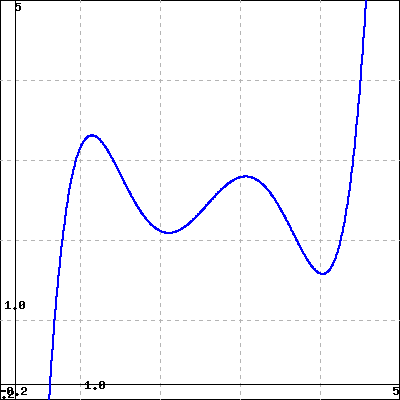
2.
3.
4.
The table above gives the annual sales (in millions of dollars) of a product from 1998 to 2006. What was the average rate of change of annual sales,
(a) between 2001 and 2002?
(b) between 2001 and 2004?
5.
6.
A driver of a car stopped at a gas station to fill up his gas tank. He looked at his watch, and the time read exactly 3:40 p.m. At this time, he started pumping gas into the tank. At exactly 3:44, the tank was full and he noticed that he had pumped 17 gallons.
What is the average rate of flow of the gasoline into the gas tank? gal/min
7.
8.
9.
10.
11.
12.
13.
14.
Let \(\ f(x) = 25 - x^2\text{.}\)
a) Compute each of the following expressions and interpret each as an average rate of change:
(i) \(\ \ \ \frac{f( 3 ) - f(0)}{ 3 - 0} = \ \)
(ii) \(\ \ \frac{f( 5 ) - f( 3 )}{5 - 3 } = \ \)
(iii) \(\ \frac{f( 5 ) - f(0)}{5 - 0} = \ \)
b) Based on the graph sketched below, match each of your answers in (i) - (iii) with one of the lines labeled A - F. Type the corresponding letter of the line segment next to the appropriate formula. Clearly not all letters will be used.
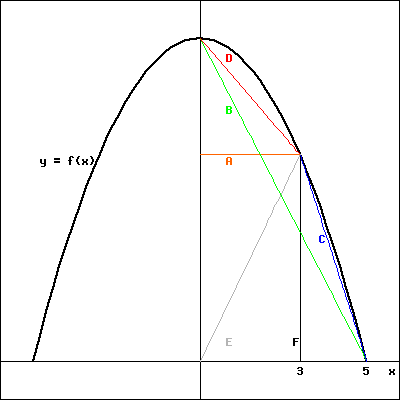
Line A is horizontal from the point \((3,f(3))\) to the y axis.
Line F is vertical from the point \((3,f(3))\) to the x axis.
(click on image to enlarge)
| \(\frac{f( 3 ) - f(0)}{ 3 - 0}\) | |
| \(\frac{f( 5 ) - f( 3 )}{5 - 3 }\) | |
| \(\frac{f( 5 ) - f(0)}{5 - 0}\) |
Solution.
a)
i) \(\frac{f( 3 ) - f(0)}{ 3 - 0} = \frac{ 16 - 25 }{3 - 0} = \frac{ -9 }{ 3} = -3\)
ii) \(\frac{f( 5 ) - f( 3 ) }{ 5 - 3 } = \frac{ 0 - 16}{5 - 3} = \frac{ -16 }{ 2} = -8\)
iii) \(\frac{f( 5 ) - f(0)}{ 5 - 0} = \frac{ 0 - 25 }{ 5 - 0} = \frac{ -16 }{ 5} = -5\)
b) The formulas in parts (i), (ii), and (iii) represent the average rate of change of \(f(x)\) over the intervals \(0 \leq x \leq 3\) , \(3 \leq x \leq 5\) , and \(0 \leq x \leq 5\) respectively. Thus line segment D connecting the points (0, 25 ) and ( 3, 16 ) illustrates formula (i), line segment C connecting the points ( 3, 16 ) and ( 5, 0 ) illustrates formula (ii), and line segment B connecting the points (0, 25 ) and ( 5, 0 ) illustrates formula (iii).
15.
16.
Consider the function \(f(x) = 7 x - 2\) and find the following:
Solution.
SOLUTION\((-1, f(-1))\)\(( 1 , f( 1 ))\)
\begin{equation*}
\frac{ f( 1 ) - f(-1) }{1 - (-1)}
= \frac{ 5 + 9 }{1 + 1}
= \frac{ 14}{2 } = 7
\end{equation*}
\((a, f(a))\)\(( b , f(b))\)
\begin{equation*}
\frac{ f(b) - f(a) }{b - a}
= \frac{ (7 b - 2) - (7 a - 2) }{b - a}
= \frac{ 7 b - 7 a}{b-a}
= \frac{ 7 (b-a) }{b-a} = 7
\end{equation*}
\((x, f(x))\)\(( x+h , f(x+h))\)
\begin{equation*}
\frac{ f(x+h) - f(x) }{(x+h) - x}
= \frac{ (7 (x+h) - 2) - (7 x - 2) }{h}
= \frac{ 7 x + 7 h -2 - 7 x + 2}{h}
= \frac{ 7 h }{h} = 7
\end{equation*}
17.
Calculate the successive average rates of change for the function, \(H(x)\) in the table below.
| \(x\) | 12 | 14 | 16 | 18 |
| \(H(x)\) | 21.7 | 22.02 | 22.19 | 22.3 |
(a) The average rate of change over the interval \(12 \leq x \leq 14\) is
(Retain at least 3 decimal places in your answer.)
(b) The average rate of change over the interval \(14 \leq x \leq 16\) is
(Retain at least 3 decimal places in your answer.)
(c) The average rate of change over the interval \(16 \leq x \leq 18\) is
(Retain at least 3 decimal places in your answer.)
(d) Based your answers for the rates of change, the function \(H(x)\) is
-
Concave Up
-
Concave Down
-
Neither concave up or concave down
-
Both concave up and concave down
Solution.
SOLUTION\(x= 12\)\(x = 14\)
\begin{equation*}
\frac{\triangle H}{\triangle x} = \frac{22.02 - 21.7}{14-12} = \frac{0.32}{2} = 0.16
\end{equation*}
\(x= 14\)\(x = 16\)
\begin{equation*}
\frac{\triangle H}{\triangle x} = \frac{22.19 - 22.02}{16-14} = \frac{0.17}{2} = 0.085
\end{equation*}
\(x= 16\)\(x = 18\)
\begin{equation*}
\frac{\triangle H}{\triangle x} = \frac{22.3 - 22.19}{18-16} = \frac{0.11}{2} = 0.055
\end{equation*}
\(x\)
18.
-
What is the average rate of change of \(g(x) = {-2-7x}\) between the points \((-2, {12})\) and \((4,{-30})\text{?}\)The average rate of change is .
Solution.
-
\(\displaystyle{\hbox{average rate of change of }g =\frac{\Delta y}{\Delta x}= \frac{{-30} - ({12})}{4 -(-2)}}\) \(\displaystyle{ = \frac{-30 - 12}{4 + 2}= \frac{{-42}}{{6}} = -7.}\)
-
Since the graph of \(g\) is a straight line, the average rate of change of \(g\) is constant. By part (a), this constant average rate of change is equal to \(-7\text{,}\) which is a negative number. Hence \(g\) is decreasing on the given interval (and in fact over any interval).
19.
20.
Given the function
\begin{equation*}
f(x) = \displaystyle \frac{x - 3}{x + 4}
\end{equation*}
find the following.
21.
22.
23.
For the function \(\small{f(x) = x^{2}+3x}\text{,}\) simplify each expression as much as possible.
| 1. | \(\large{\frac{f(x \;+\; h) \;-\; f(x)}{h}}, \small{h \ne 0}:\) | |
| 2. | \(\large{\frac{f(w) \;-\; f(x)}{w \;-\; x}}, \small{x \ne w}:\) |
Solution.
\(\small{f(x) = x^{2}+3x, \;f(x + h) = \left(x+h\right)^{2}+3\mathopen{}\left(x+h\right)}\text{.}\)
\begin{align*}
\small{\frac{f(x \;+\; h) \;-\; f(x)}{h}} \amp = \frac{\left(x+h\right)^{2}+3\mathopen{}\left(x+h\right) - (x^{2}+3x)}{h}\\
\amp = \small{\frac{2xh+h^{2}+3h}{h}} \\
\amp = \small{2x+3+h.}
\end{align*}
\(\small{f(x) = x^{2}+3x, \;f(w) = w^{2}+3w}\text{.}\)
\begin{align*}
\small{\frac{f(w) \;-\; f(x)}{w \;-\; x}} \amp = \frac{w^{2}+3w - (x^{2}+3x)}{w - x}\\
\amp = \small{\frac{w^{2}-x^{2}+3w-3x}{w-x}} \\
\amp = \small{\frac{\left(w+x\right)\mathopen{}\left(w-x\right)+3\mathopen{}\left(w-x\right)}{w-x}} \\
\amp = \small{\frac{\left(w-x\right)\mathopen{}\left(w+x+3\right)}{w-x}} \\
\amp = \small{w+x+3.}
\end{align*}

