visualizations
Seeing is believing
Small interactive demos of mathematical concepts and constructions.
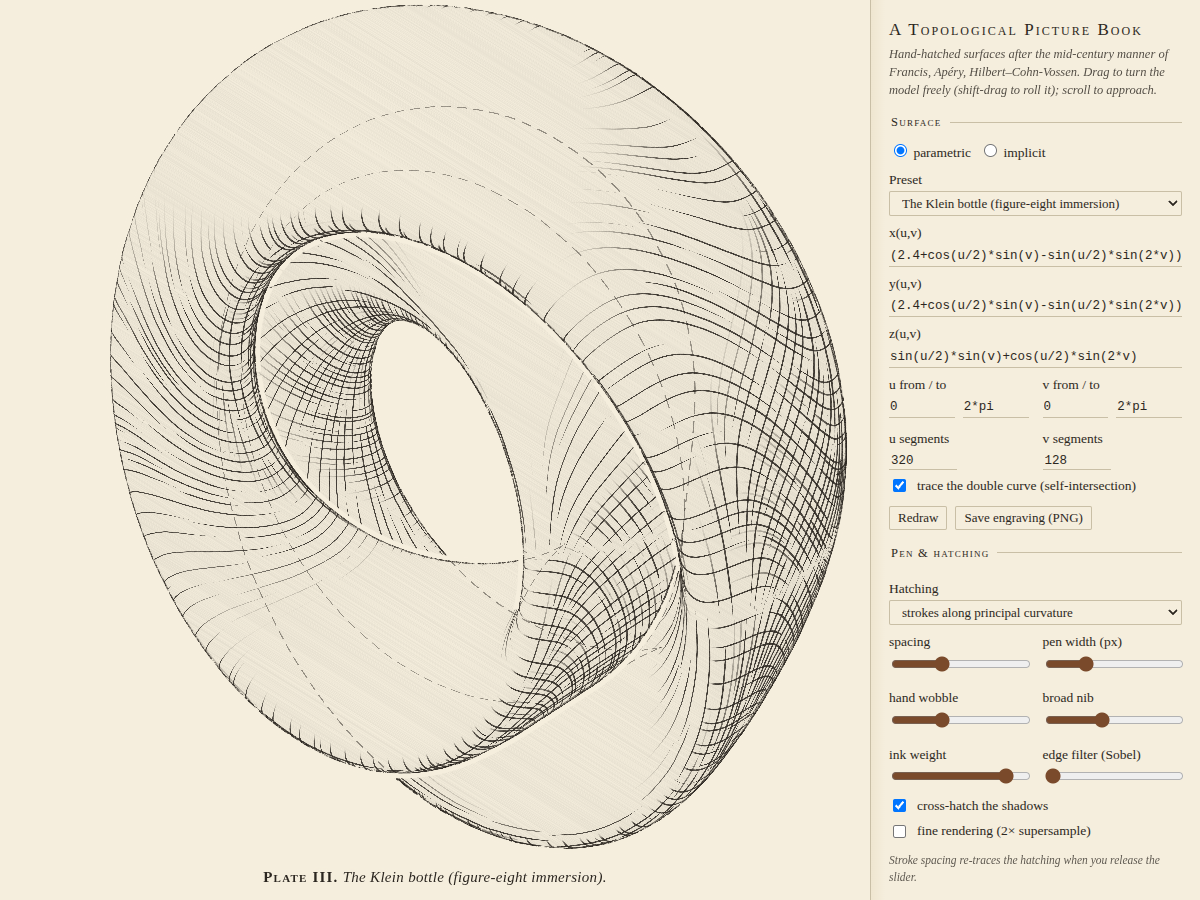
A topological picture book
Pen-and-ink plates of parametric and implicit surfaces in the manner of Francis: silhouettes with cusps, hidden lines dashed, haloes at crossings, double curves of immersions, and hatching traced along principal curvature. Klein bottle, Boy’s surface, and a knotted torus are built in; type your own.
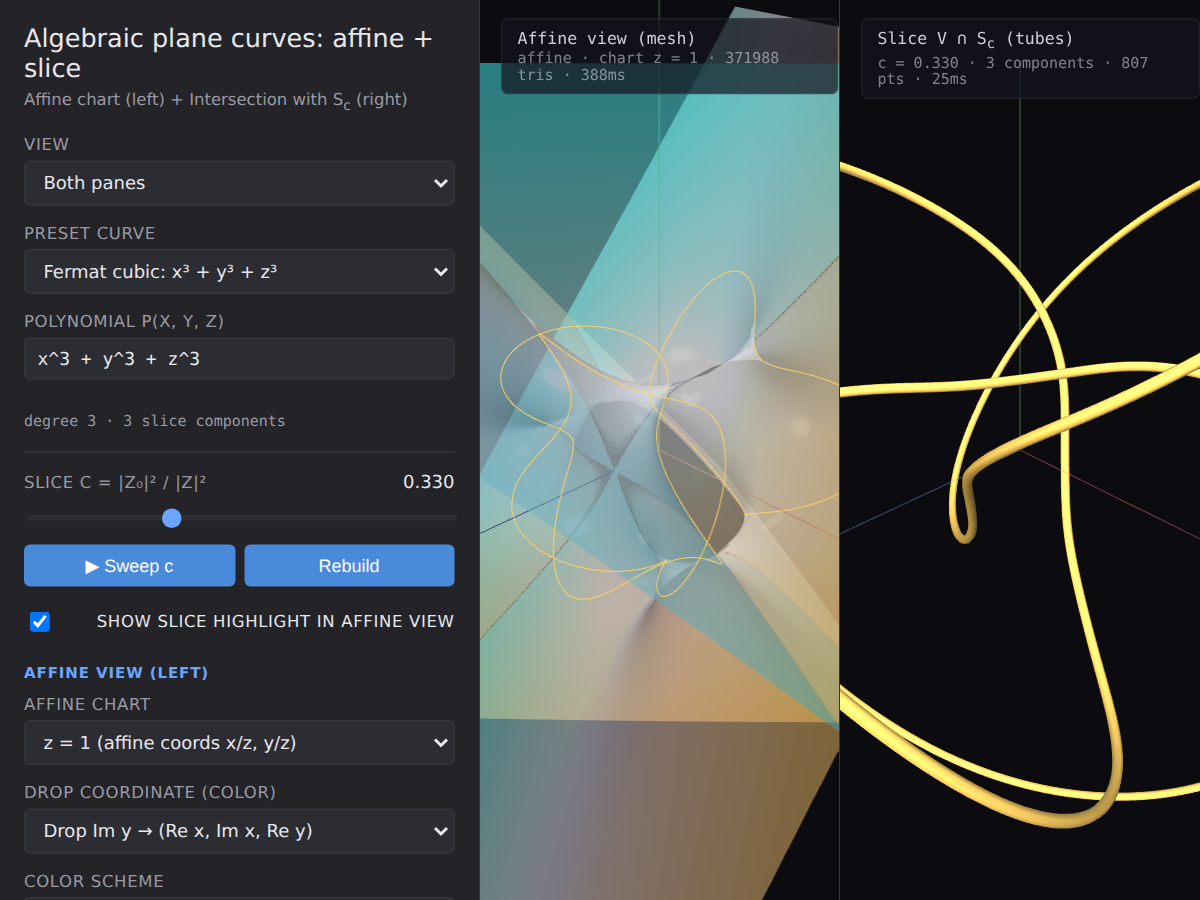
Algebraic plane curves
A curve and its dual, side by side. Drag the coefficients and watch inflection points and bitangents migrate between the two pictures.
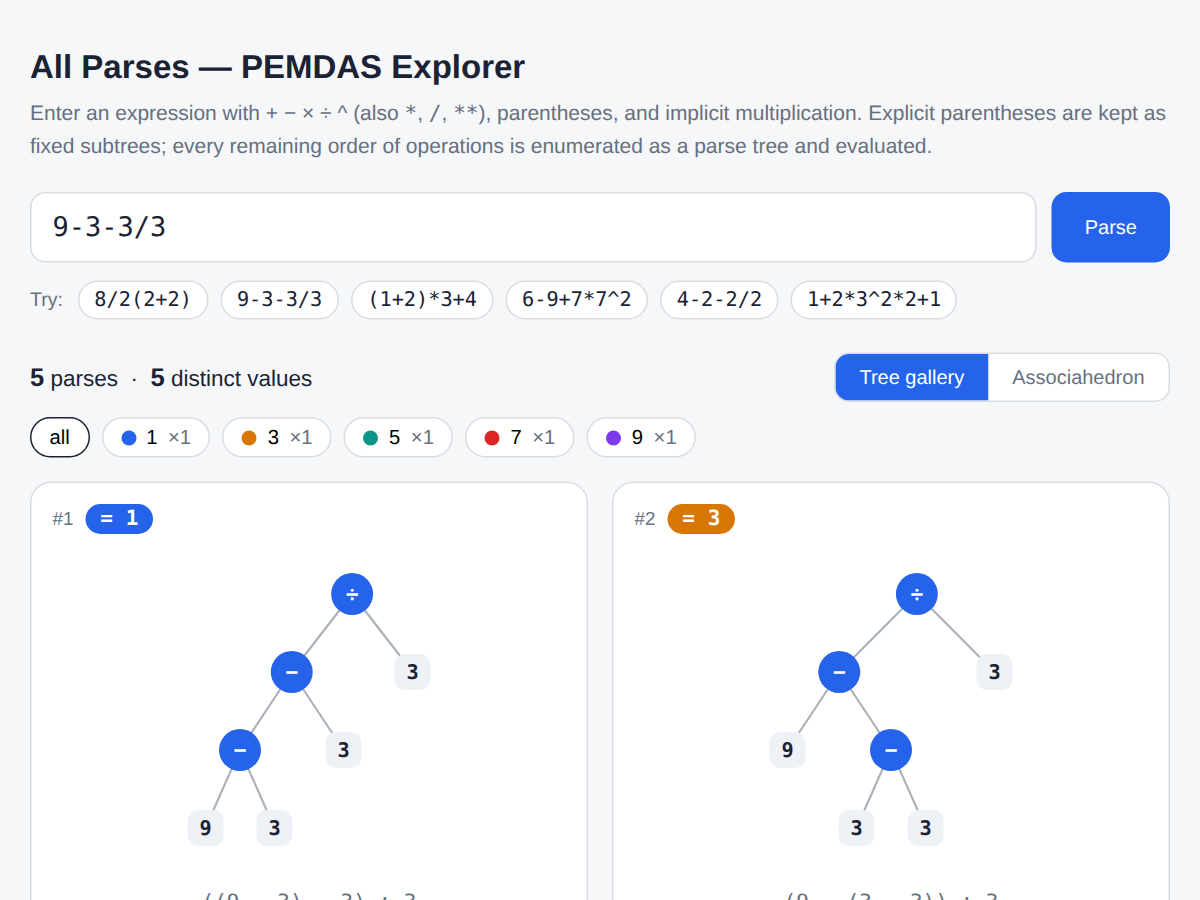
All parses: a PEMDAS explorer
Every way to parenthesize an expression, enumerated and evaluated — Catalan numbers doing their day job.
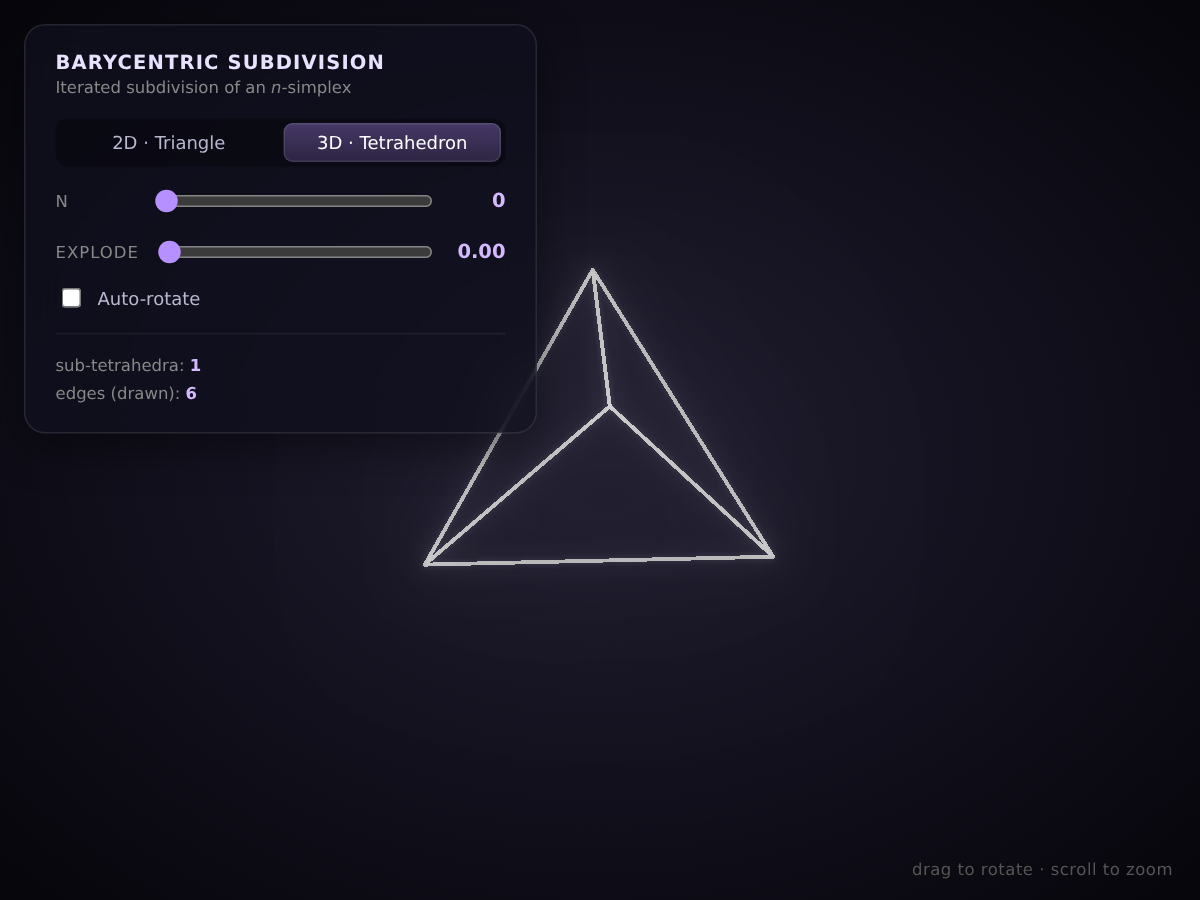
Barycentric subdivision
Iterated barycentric subdivision of a simplex, and the alarming thinness of the simplices it produces.
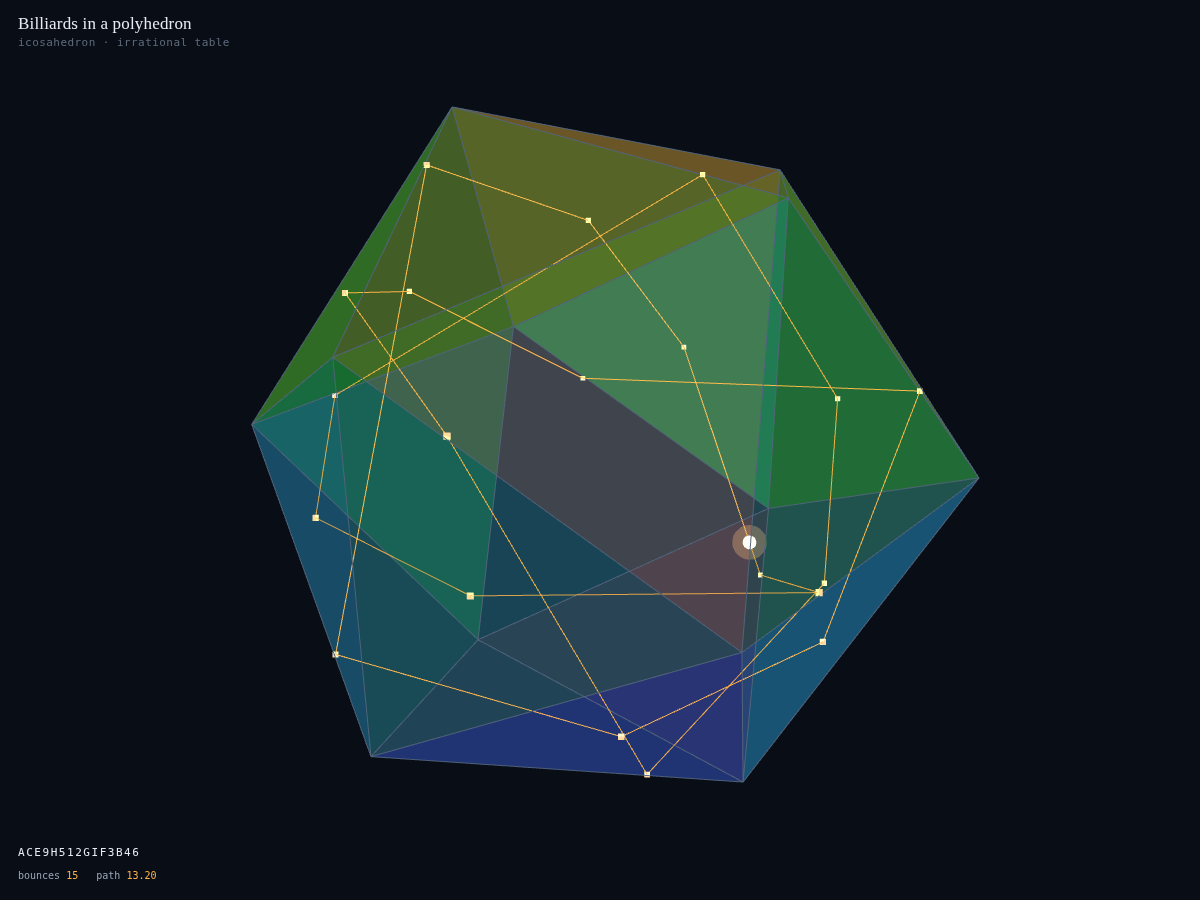
Billiards in a polyhedron
A ball bounces inside a Platonic solid, sounding a steel-pan note at every face. Presets include orbits that strike every face exactly once — the icosahedron’s is the torus knot T(3,5).
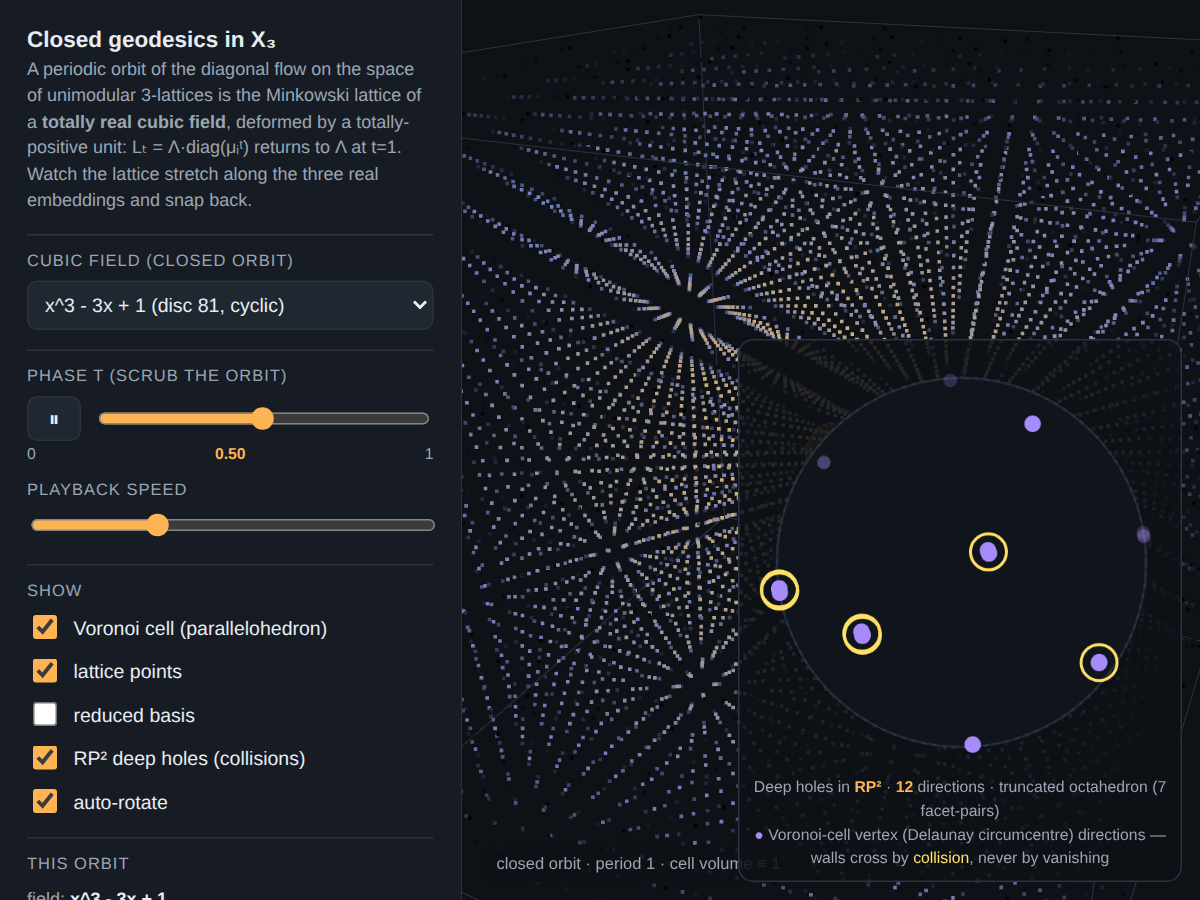
Closed geodesics in X₃
Closed geodesics in the space of lattices attached to totally real cubic fields, drawn against ℝP².
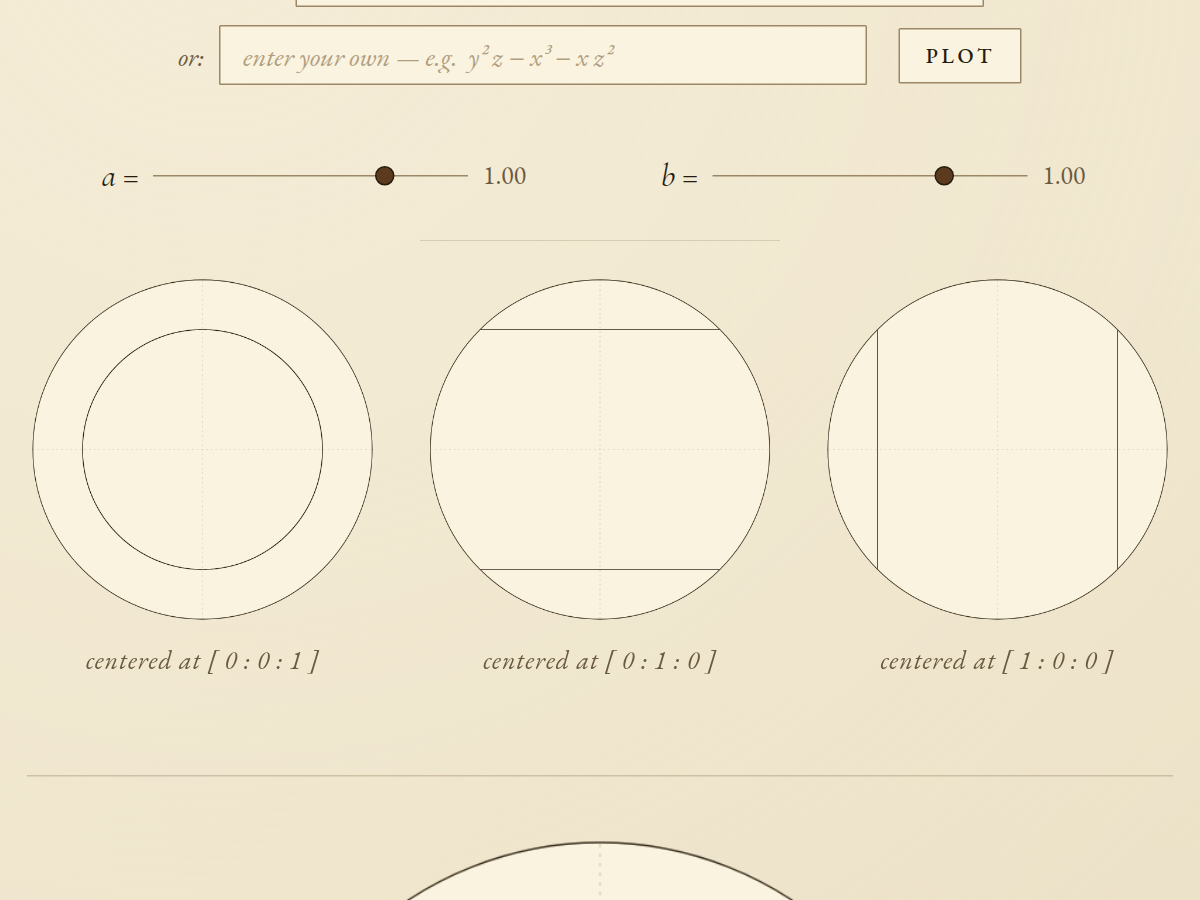
Curves in the real projective plane
Real plane curves drawn on a disc model of ℝP², where the line at infinity is just another line.
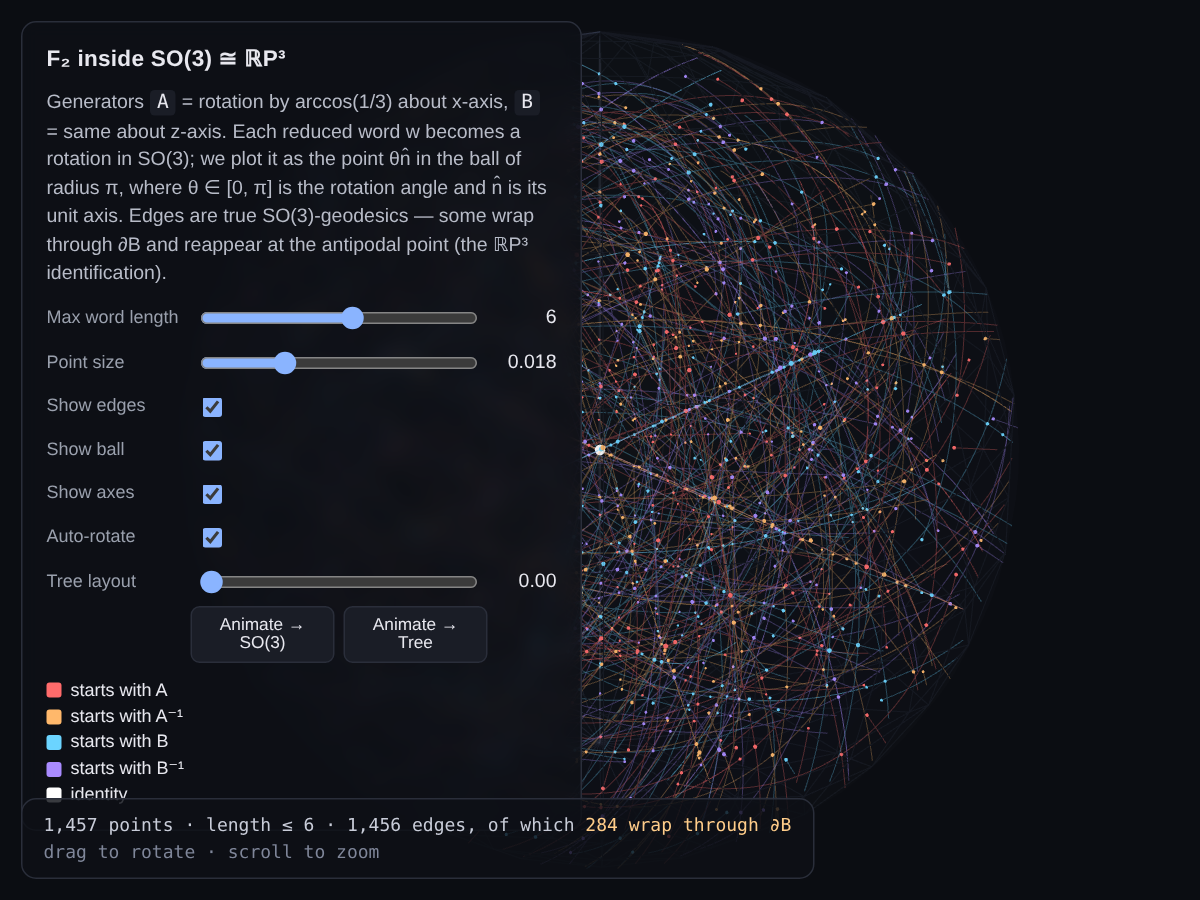
F₂ inside SO(3) ≅ ℝP³
Two generic rotations generate a free group. Here are its words, plotted in ℝP³, drifting toward the Banach–Tarski paradox.
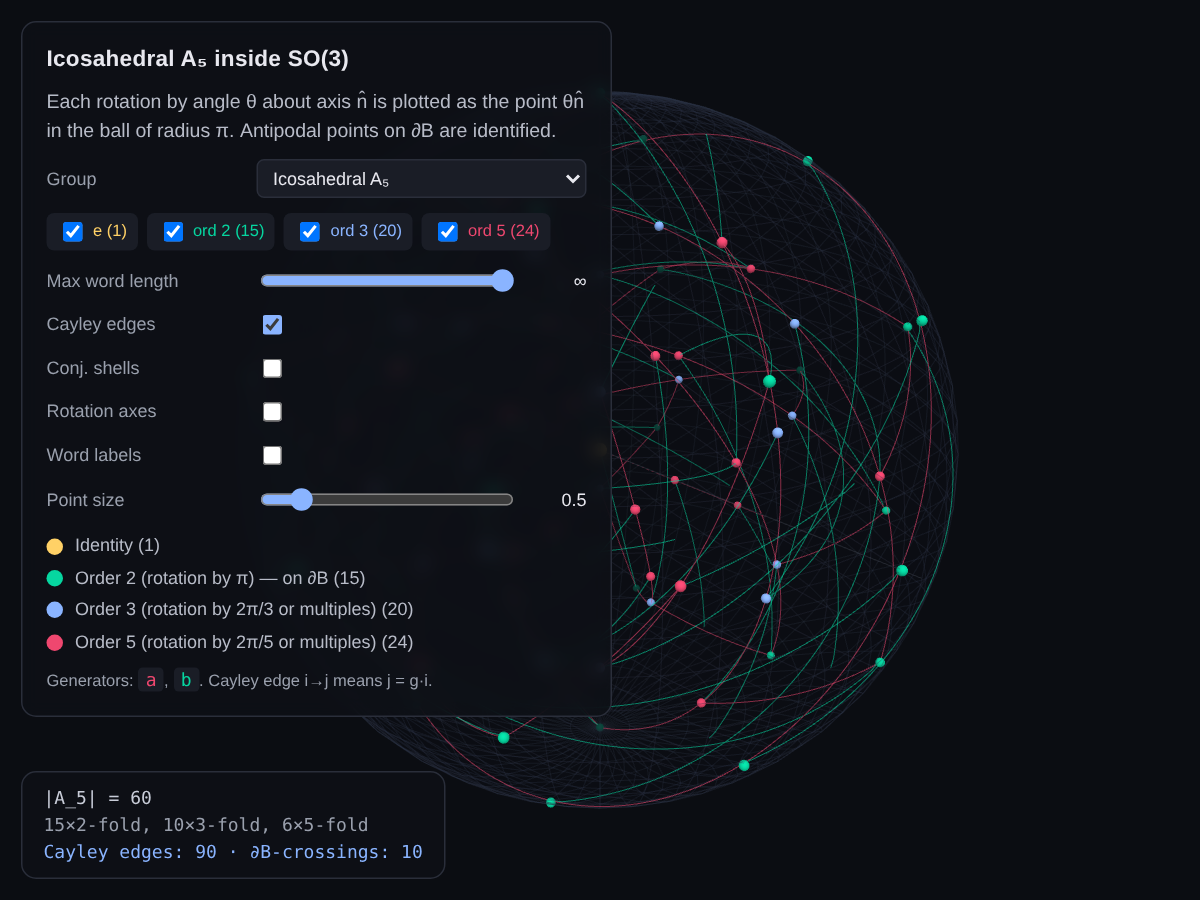
Finite subgroups of SO(3)
The cyclic, dihedral, tetrahedral, octahedral, and icosahedral groups, each shown acting on the sphere it was born to rotate.
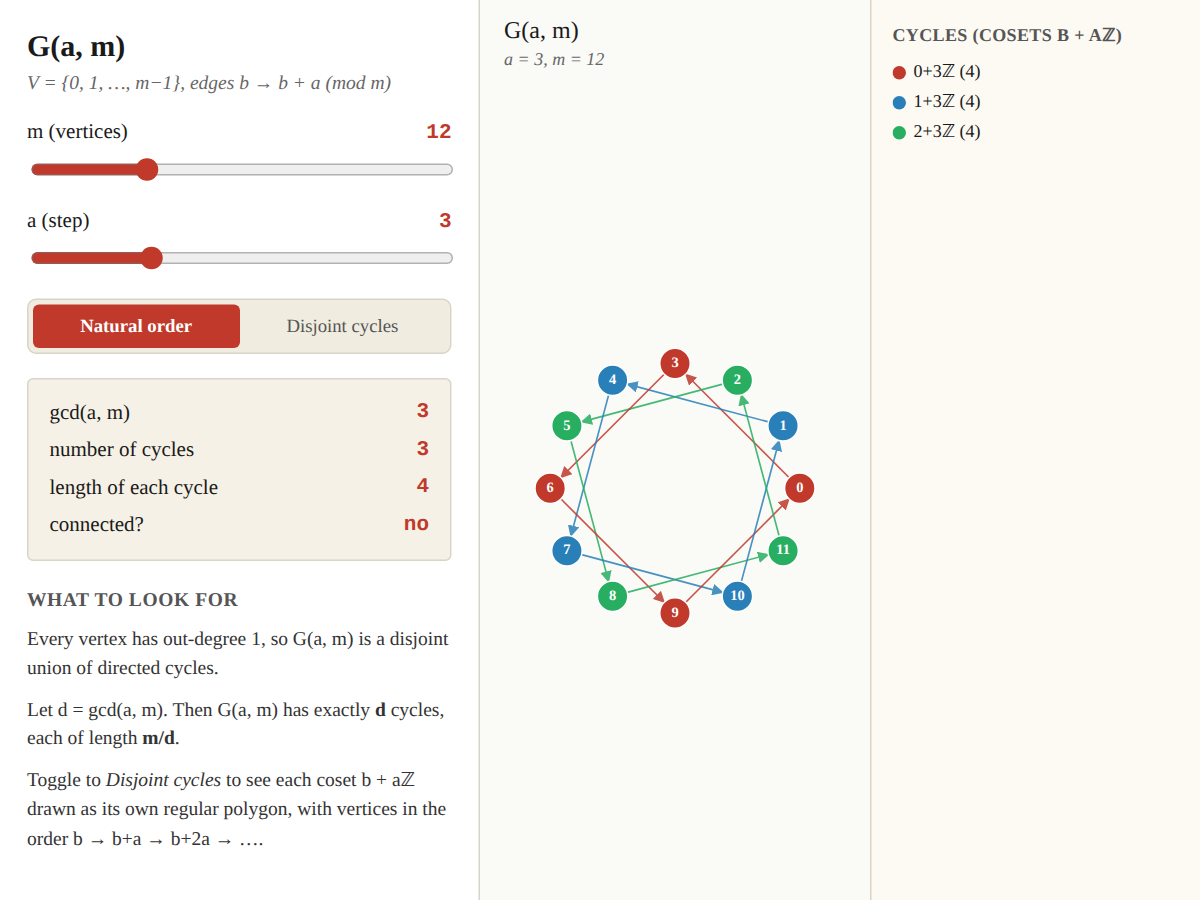
G(a, m)
The directed graph of b ↦ b + a modulo m. Change a and m and watch the cycle structure reorganize itself around gcd(a, m).
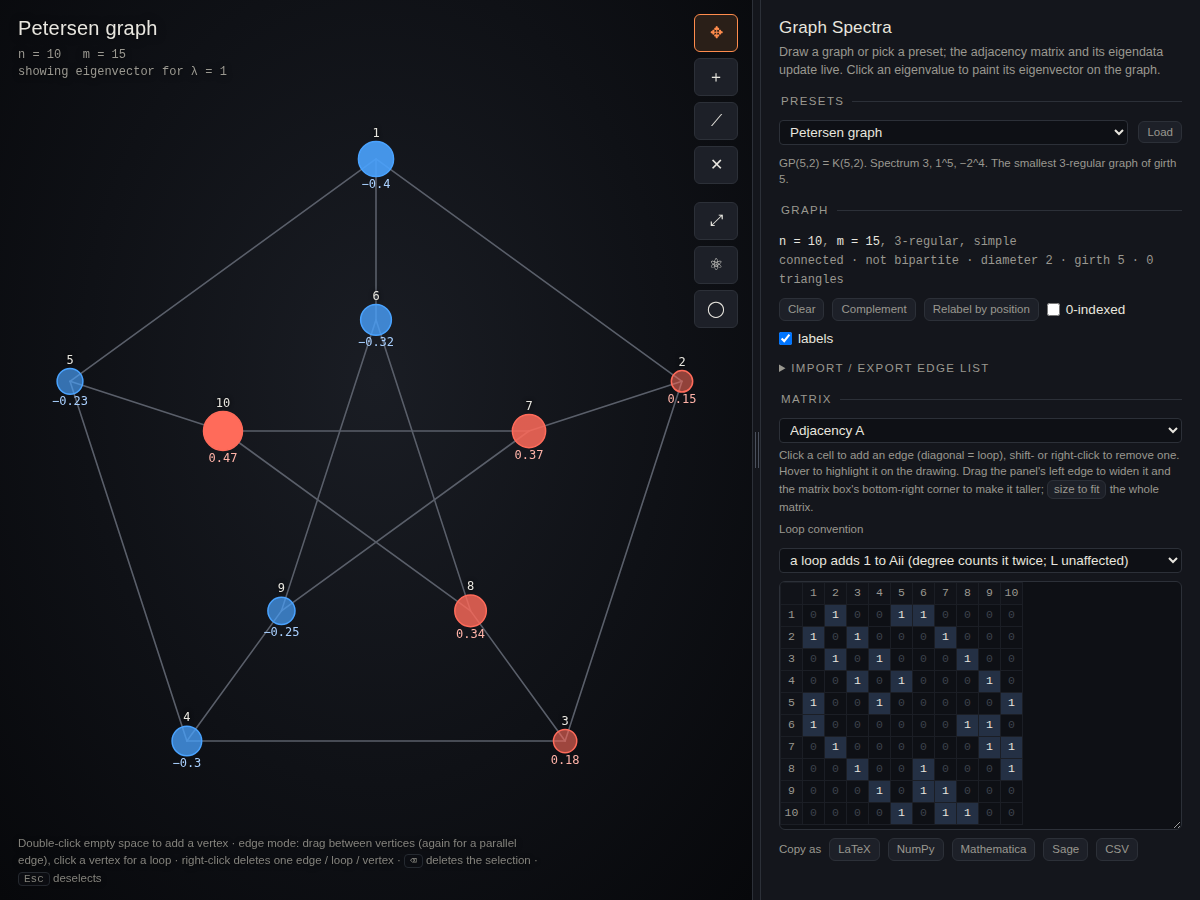
Graph spectra
Draw a graph — loops and parallel edges allowed — or pick one from a library of famous ones, and read off its adjacency, Laplacian, or Seidel matrix with eigenvalues, eigenvectors painted on the vertices, and an exact characteristic polynomial over ℤ that certifies every closed-form eigenvalue.
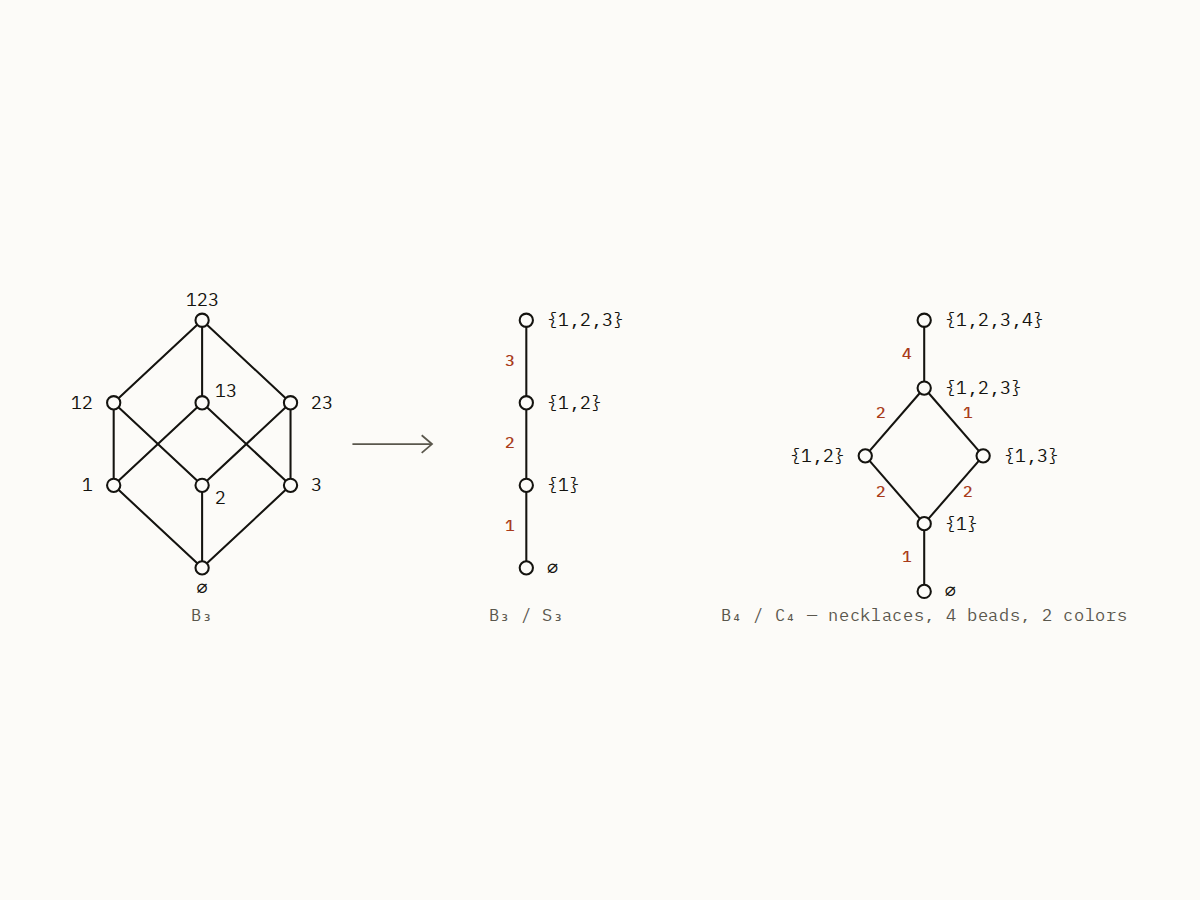
Hasse diagrams
Zoomable Hasse diagrams built for Math 372: the quotient posets of unlabeled graphs, necklaces, simplicial complexes and finite spaces, the partition lattice and its quotient by the symmetric group, and the Tamari lattice drawn on binary trees, transfer systems on a chain, and noncrossing partitions.
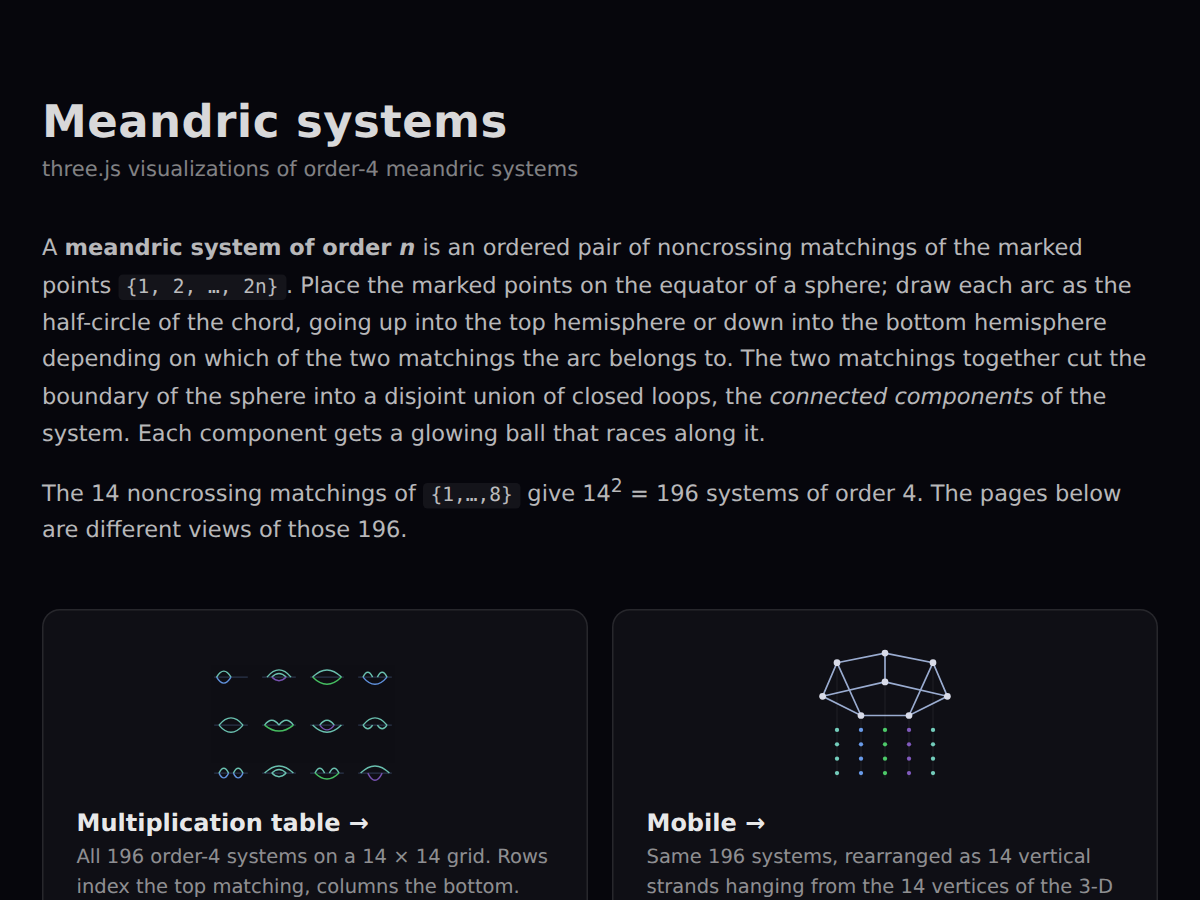
Meandric systems
Closed curves crossing a line, counted and drawn, with the associahedron and multiplication table that organize them.
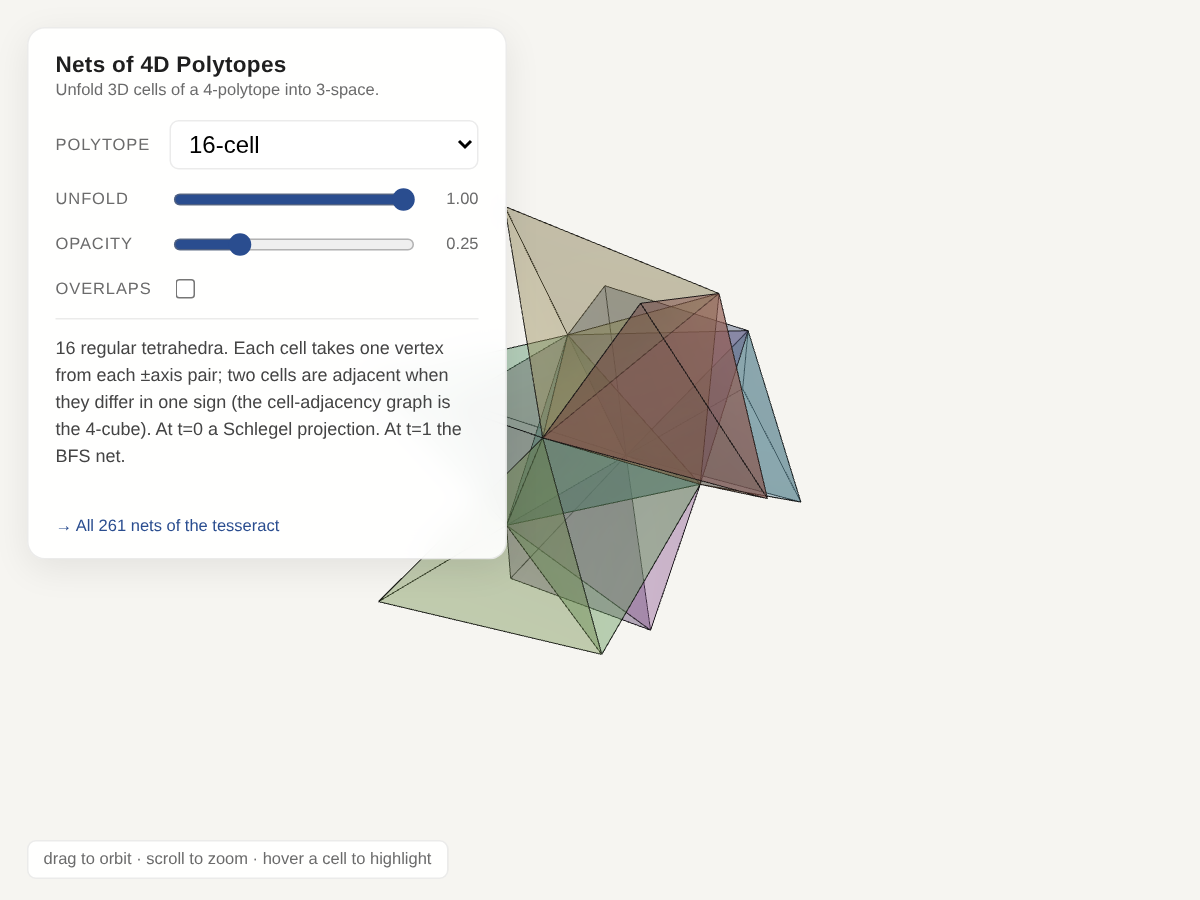
Nets of 4D polytopes
Unfoldings of the regular 4-polytopes, including all 261 nets of the tesseract.
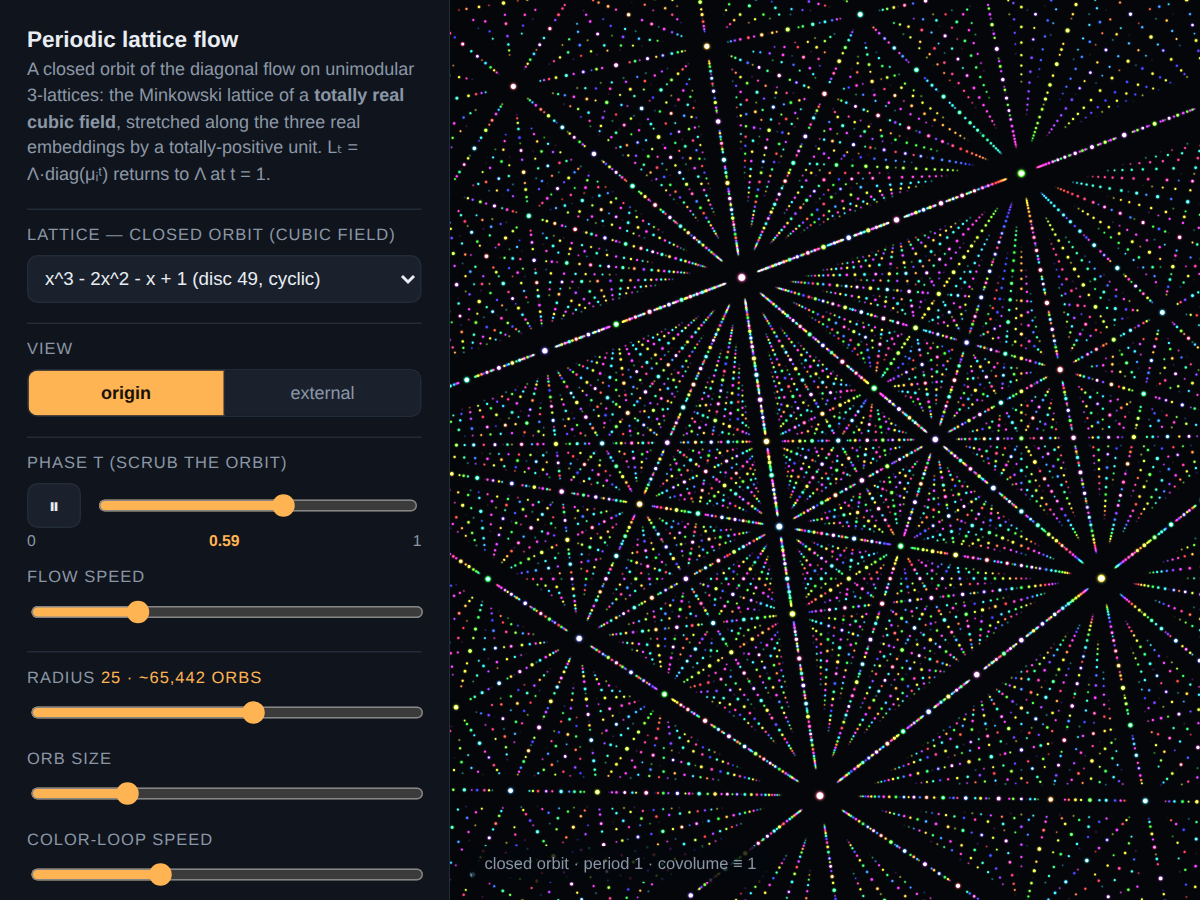
Periodic lattice flow
Orbs tracing a periodic flow on a lattice, because sometimes the right way to understand a group action is to let it run.
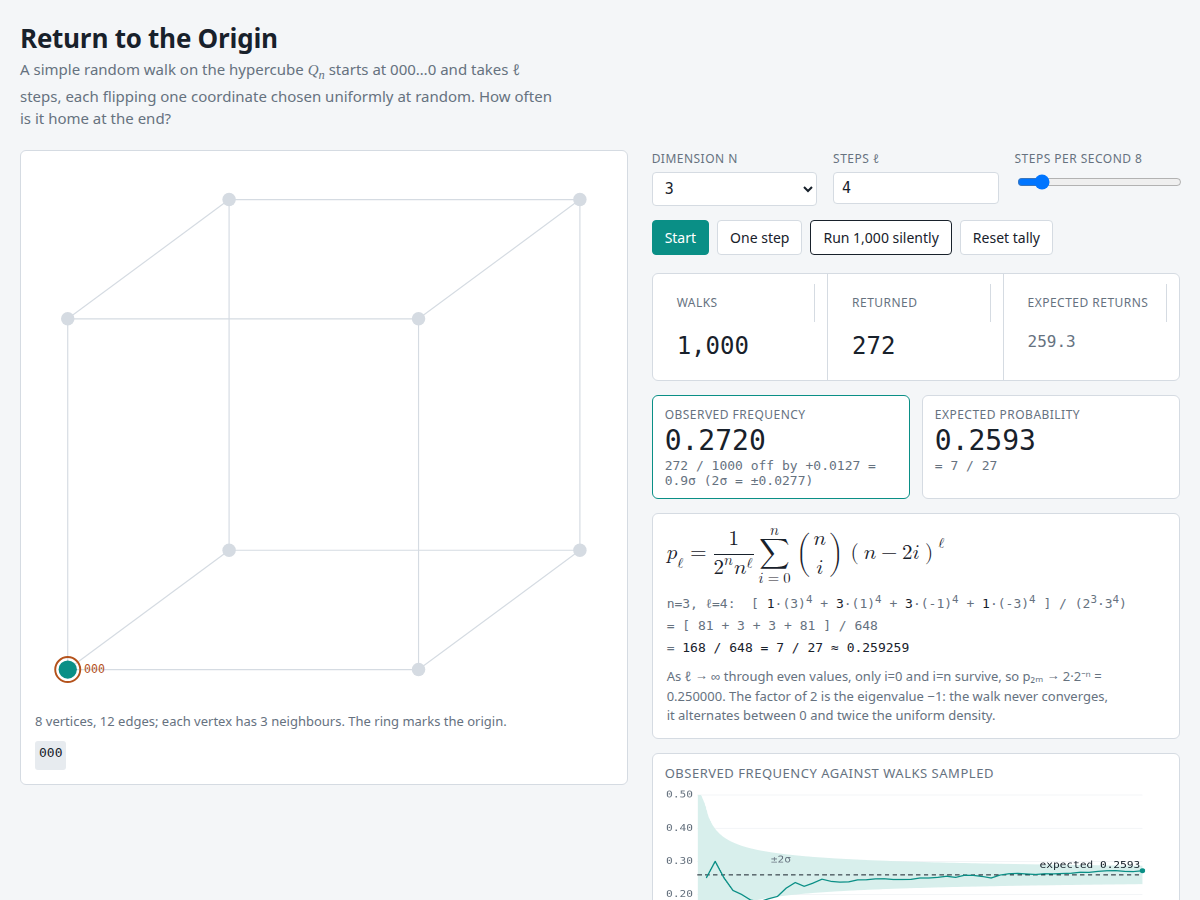
Return to the Origin
Simple random walks on the hypercube Qₙ, one flipped coordinate at a time, animated on the cube while a tally counts how often ℓ steps bring the walker home. The exact probability — the spectral count of closed walks, 2⁻ⁿ n⁻ˡ Σ C(n,i)(n−2i)ˡ — is shown term by term beside the running frequency, so the convergence, and the odd-ℓ parity obstruction, are both visible.
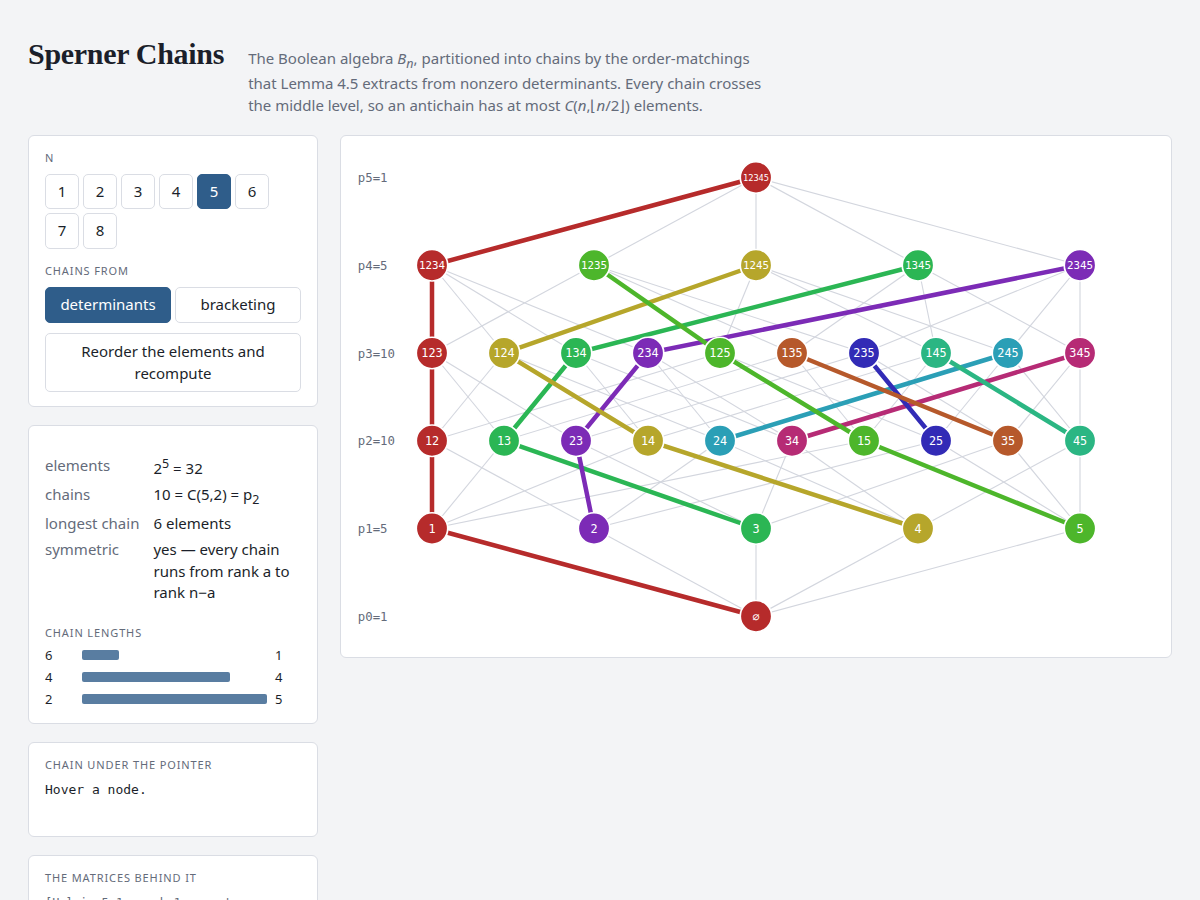
Sperner Chains
The Boolean algebra Bₙ partitioned into chains by the linear-algebra method: for each level, a square submatrix of the up-operator with nonzero determinant is chosen, a nonzero term of its expansion is extracted, and that term is an order-matching. Following the matchings through the middle level gives C(n,⌊n/2⌋) chains, which is Sperner’s theorem. Reorder the elements and the determinants return a different partition; a bracketing rule gives the symmetric one for comparison.
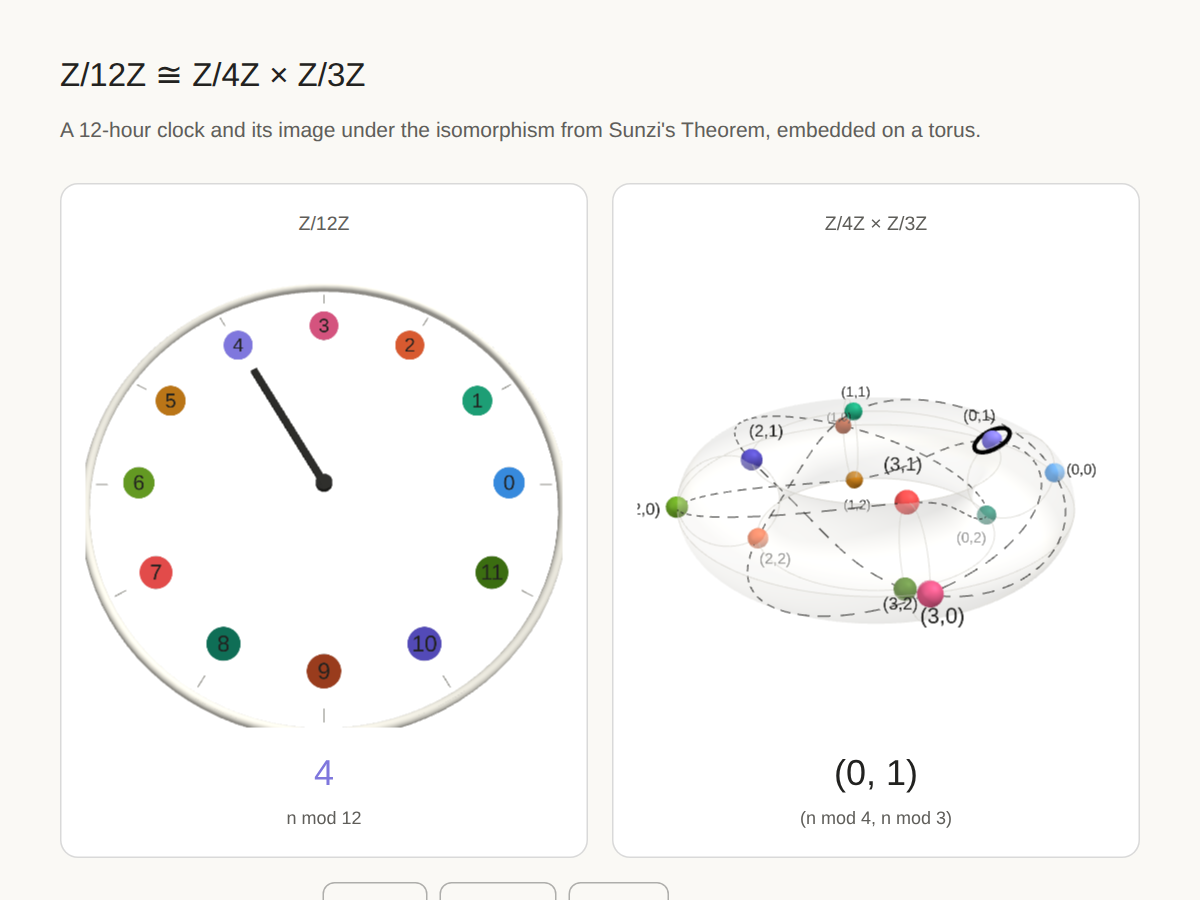
Sunzi's clock
ℤ/12 ≅ ℤ/4 × ℤ/3 as a pair of gears — the Chinese remainder theorem as a mechanism rather than a proof.
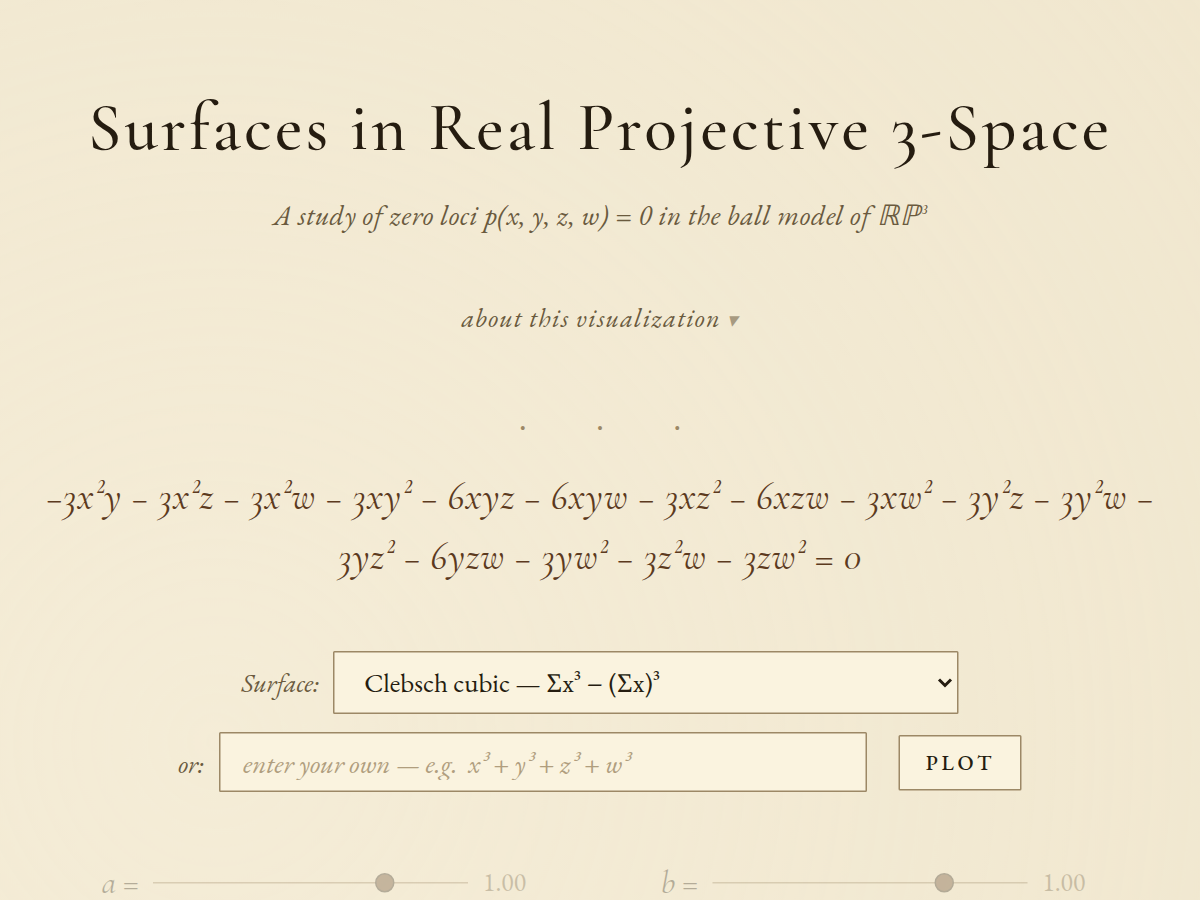
Surfaces in ℝℙ³
Cubic and quartic surfaces rendered in projective 3-space, including the ones whose singularities only make sense once you leave affine coordinates.
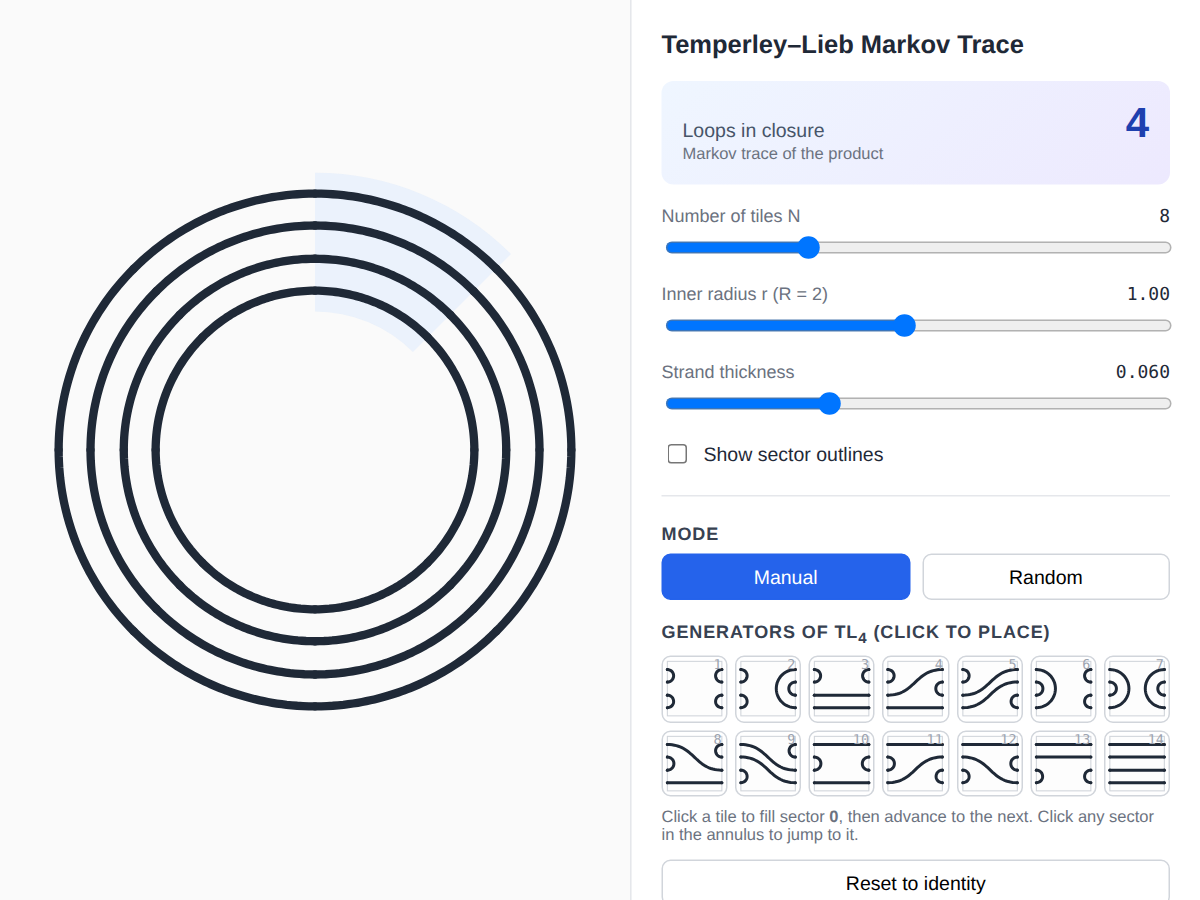
Temperley–Lieb Markov trace explorer
Temperley–Lieb diagrams and the Markov trace that turns them into knot invariants.
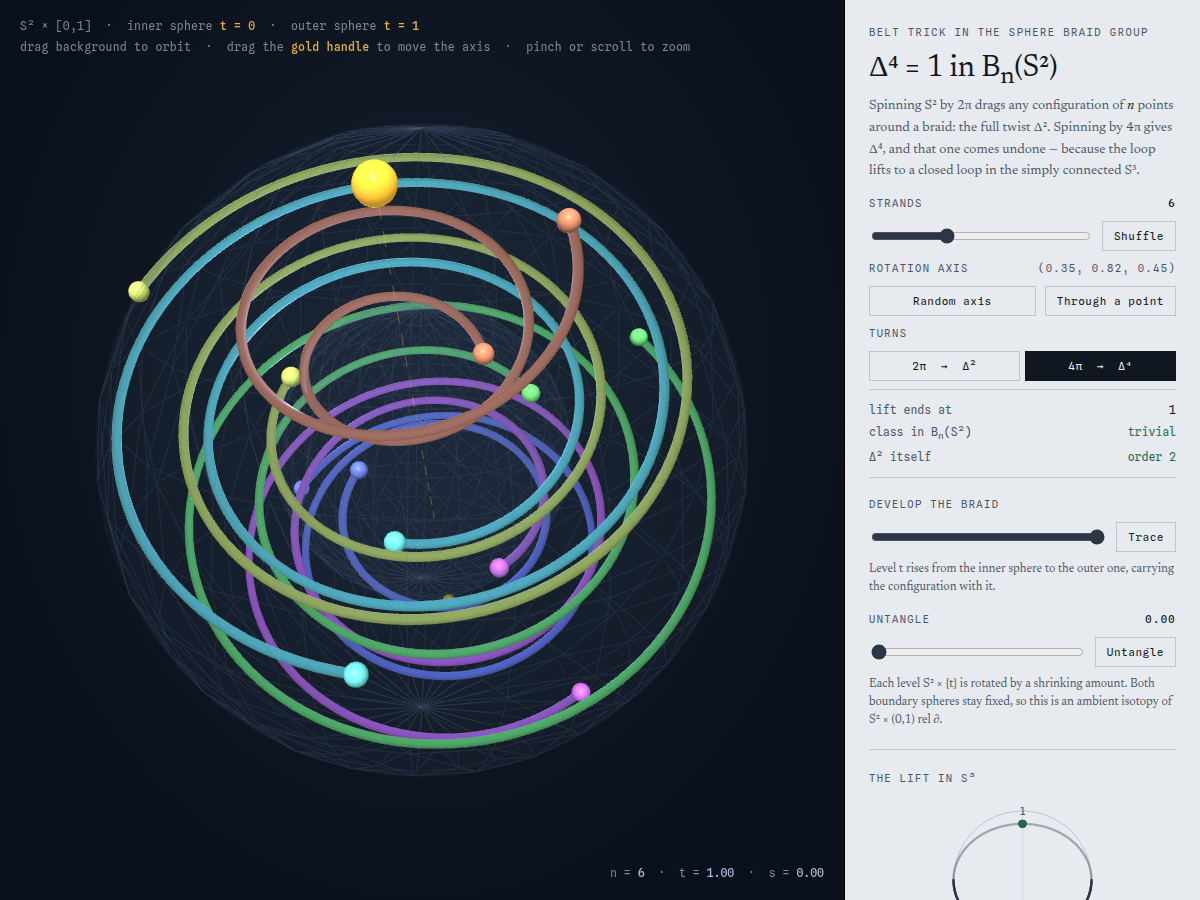
The belt trick in Bₙ(S²)
Spin S² once and n marked points drag out the full twist Δ²; spin it twice and the braid comes undone. The 4π rotation lifts to a closed loop in the simply connected S³, and contracting that loop is the isotopy that untangles the strands.
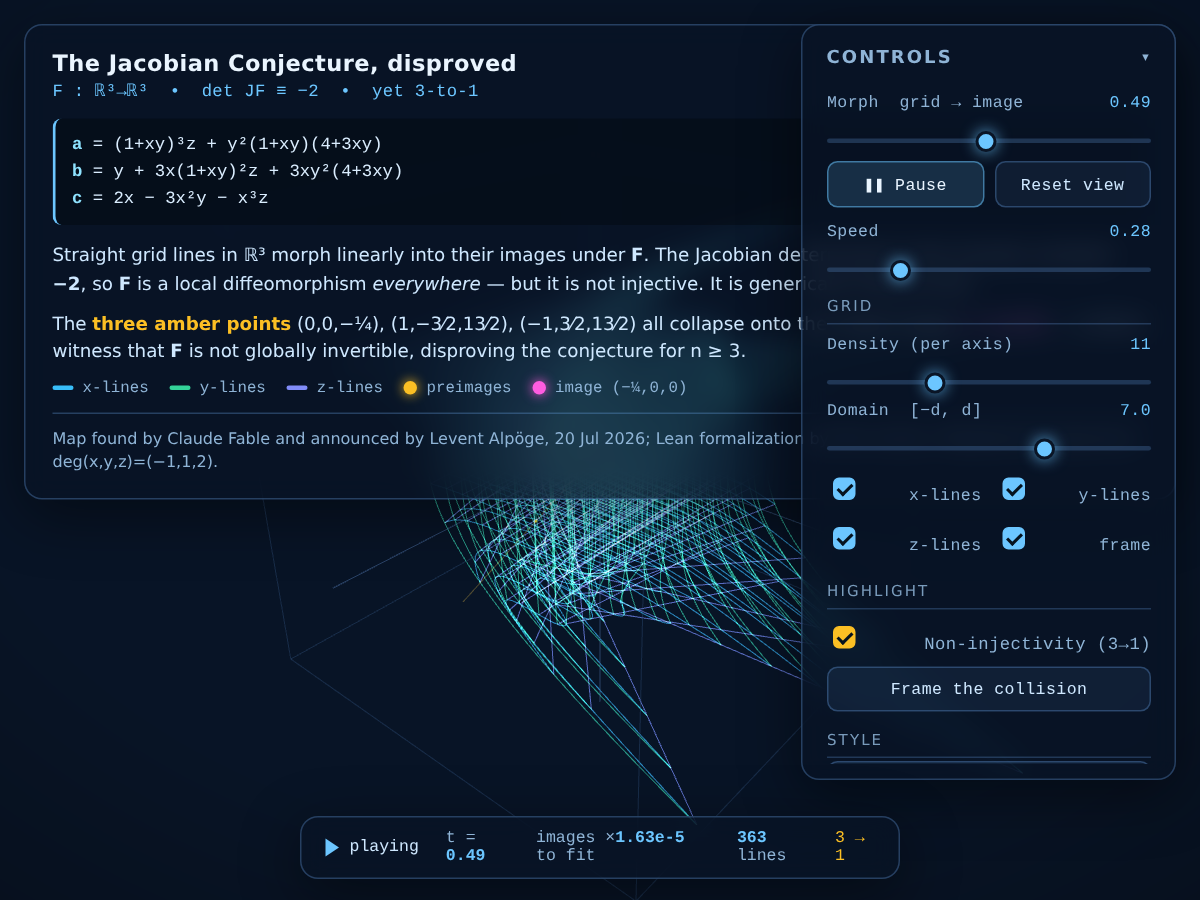
The Jacobian conjecture: a grid morph
Watching a polynomial map with constant nonzero Jacobian fold the plane — the picture that makes the conjecture feel plausible and hard at the same time.
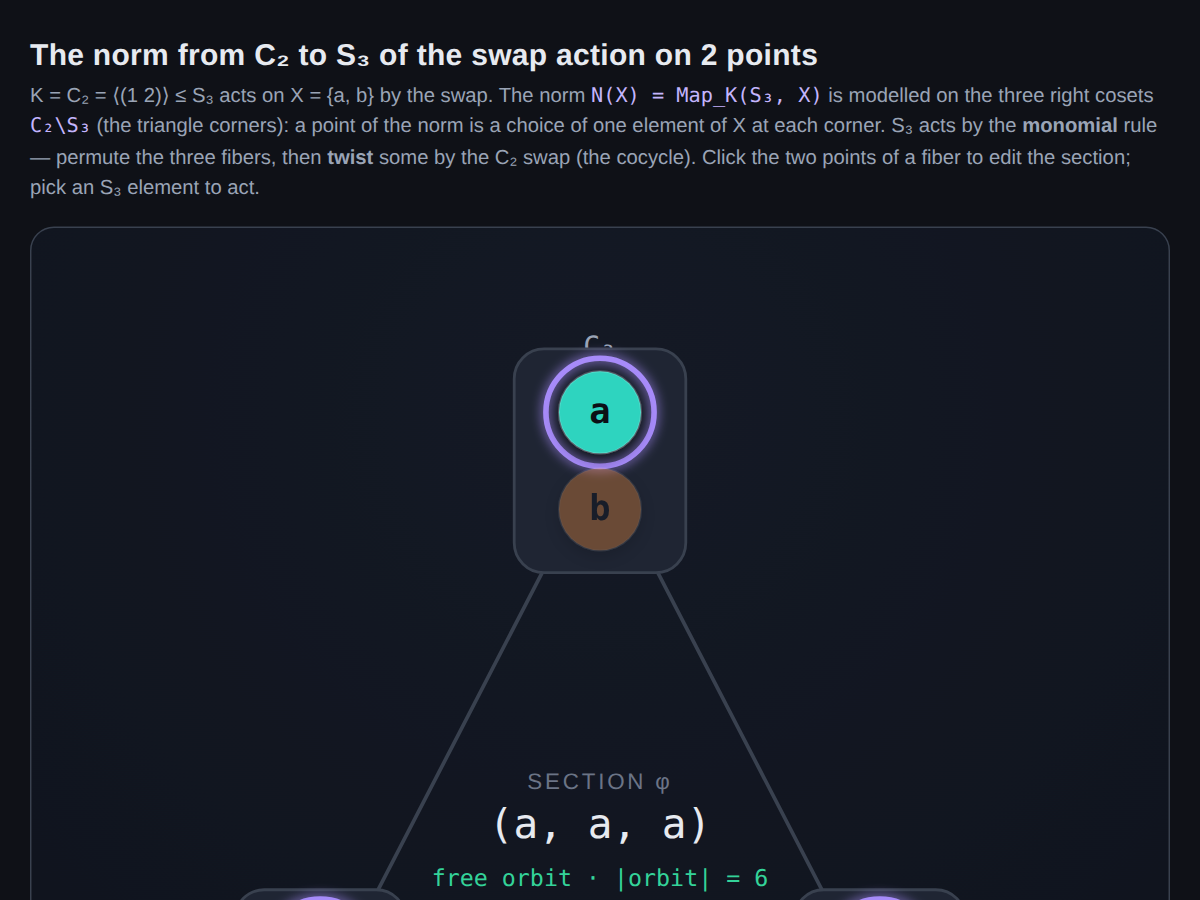
The norm N(C₂→S₃)
The multiplicative norm of the swap action, made interactive — an equivariant construction that usually only lives in a diagram.
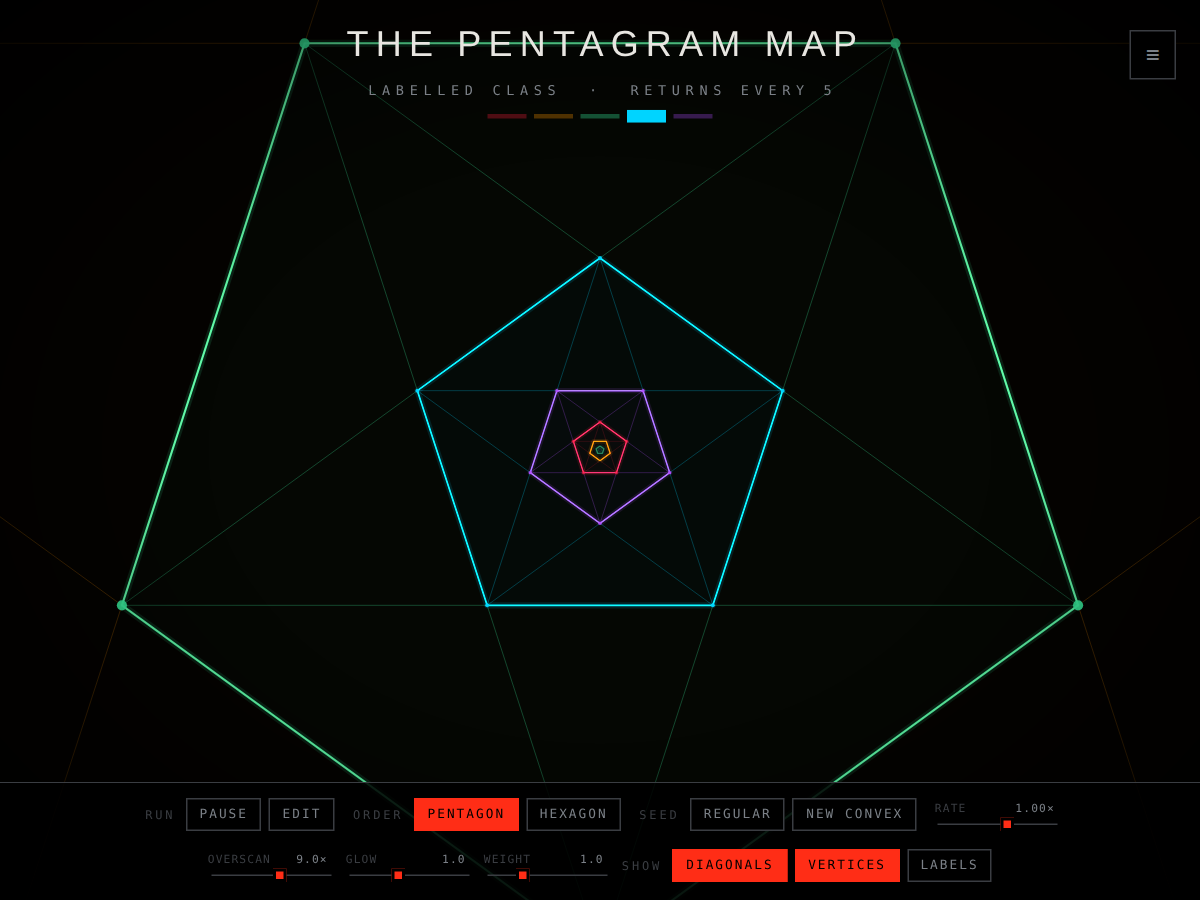
The pentagram map
Take the short diagonals of a convex polygon and keep the polygon they cut out. A pentagon returns projectively equivalent to itself, so the picture falls inward forever.
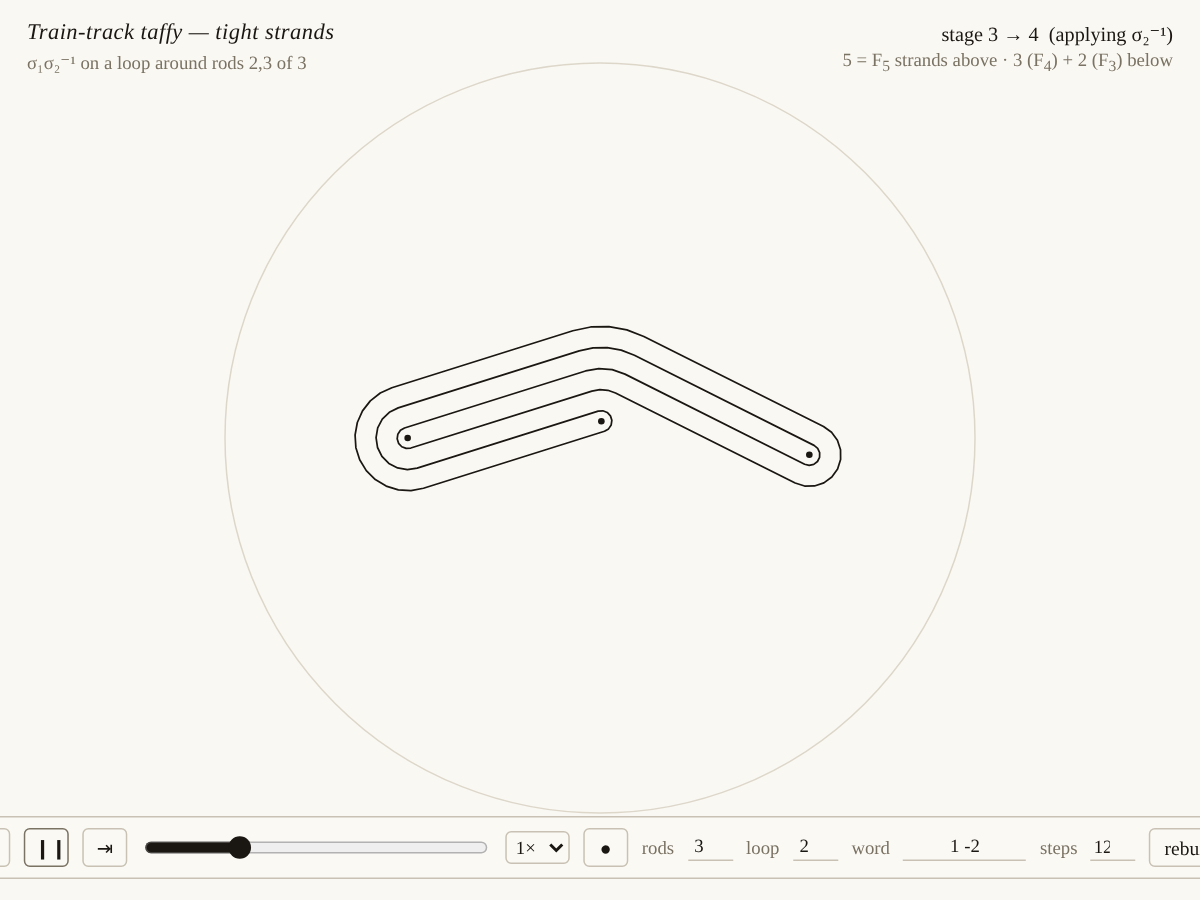
Train-track taffy
Drag a loop around two punctures through a braid word and watch it stretch. With σ₁σ₂⁻¹ on three rods the intersection counts grow like Fibonacci, and their growth rate is the dilatation.
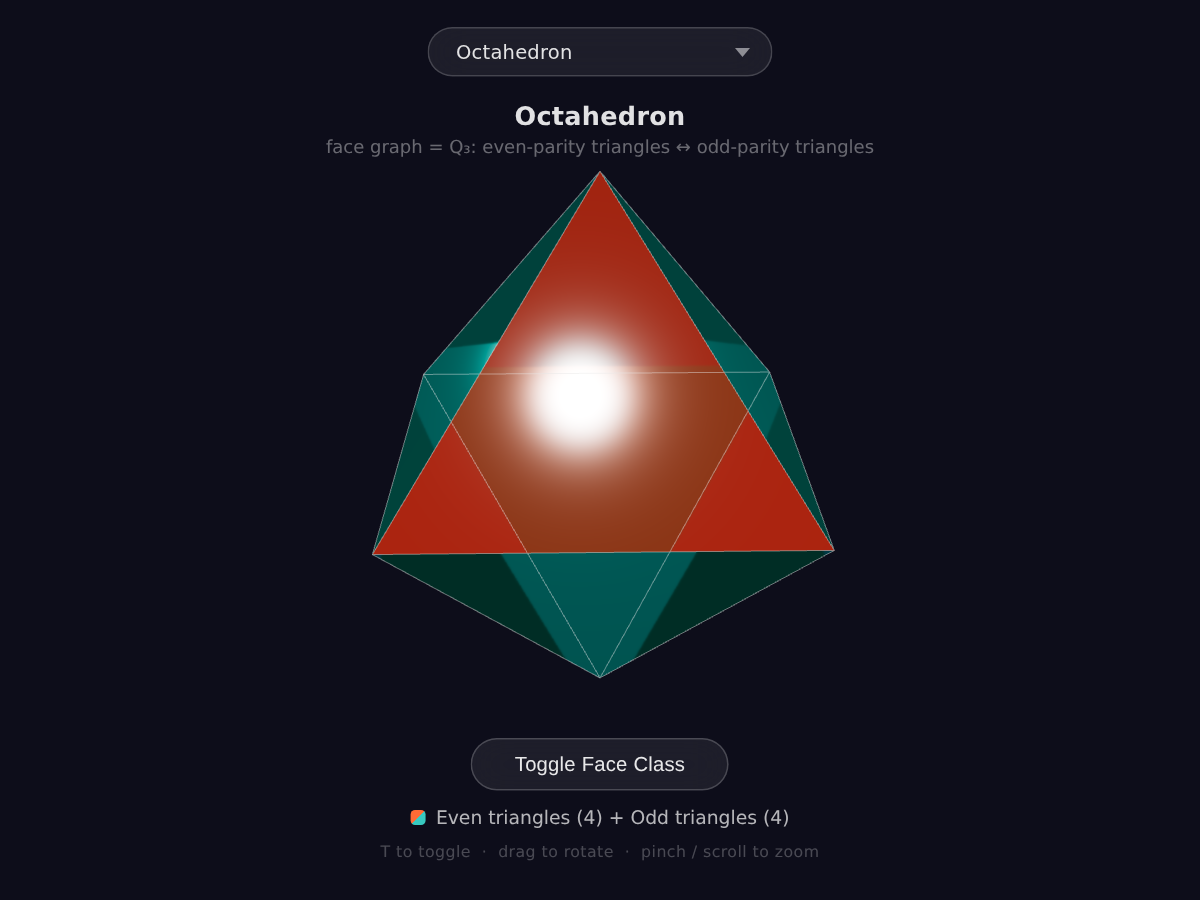
Bipartite polyhedra
Polyhedra whose graphs are bipartite, turned in space so you can check the two-coloring by eye.
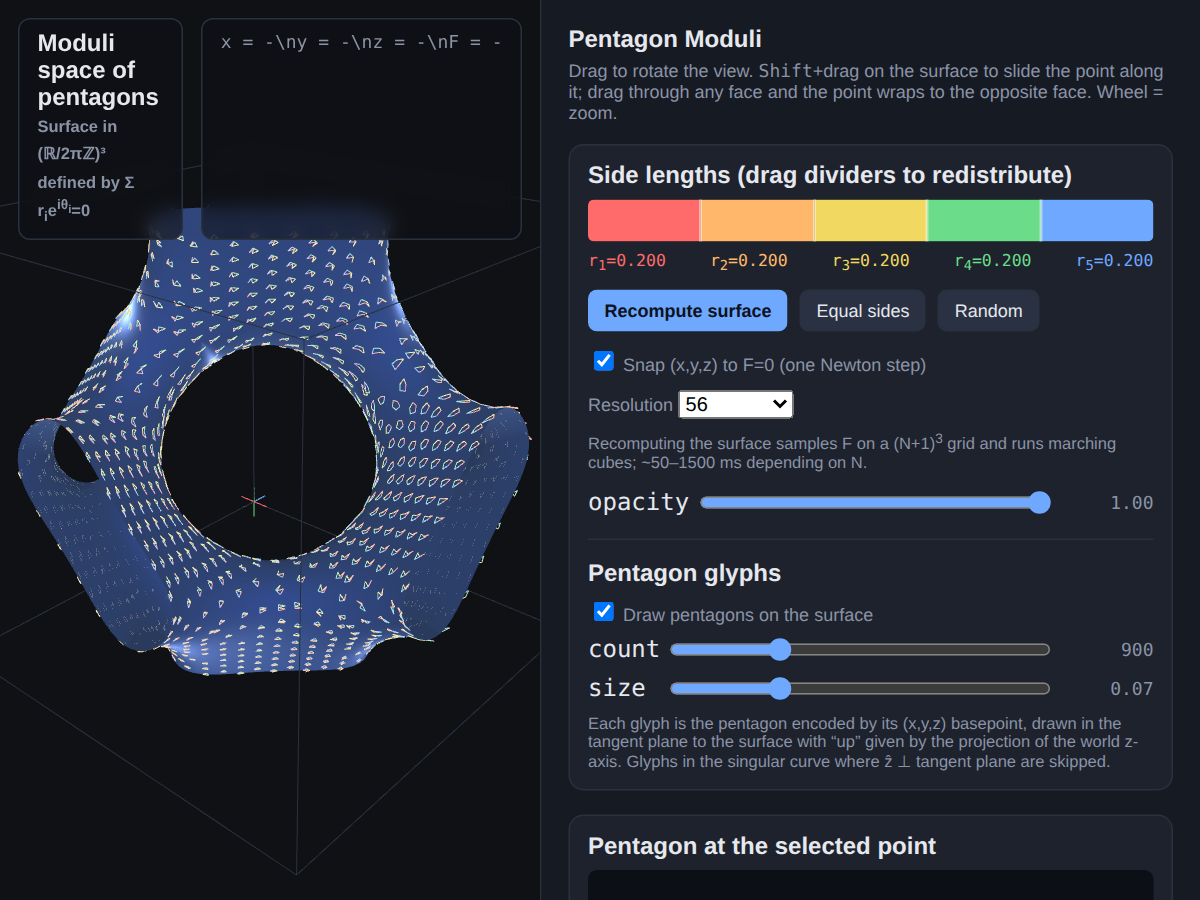
Pentagon moduli space
The space of pentagons with fixed side lengths, up to rotation — a surface you can walk around by bending a linkage.