visualizations · posets
Hasse diagrams
Zoomable Hasse diagrams — unlabeled graphs, necklaces, simplicial complexes, finite spaces, the partition lattice, Young diagrams in a box, the Tamari lattice — drawn large enough to wander around in.
A Hasse diagram draws a finite poset by its cover relation: one dot per element, a segment from x up to y when y covers x, and nothing else — transitivity is left to the reader, and height reads as rank. Past a few dozen elements the drawing needs panning and zooming, which is what these maps are for.
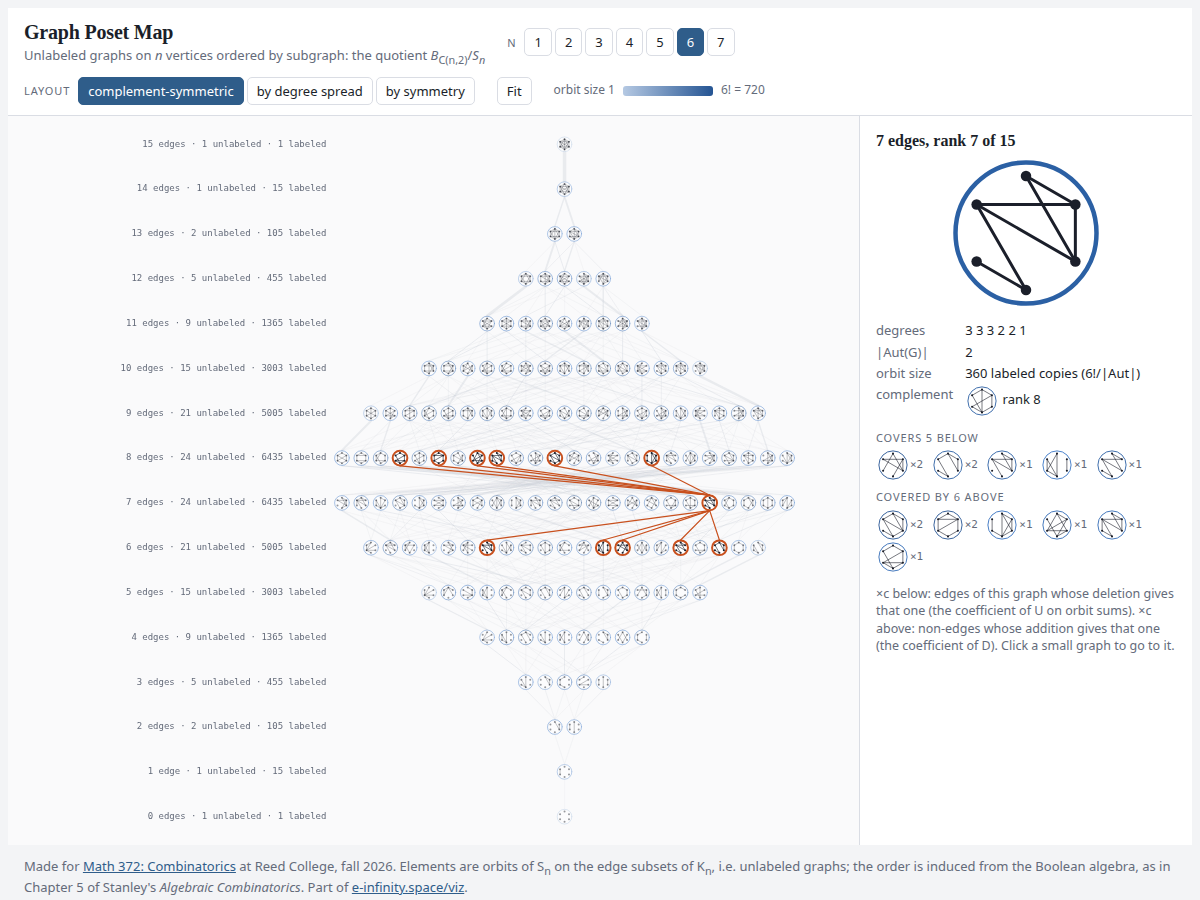
Unlabeled graphs
BC(n,2)/Sn
Graphs on n ≤ 7 vertices up to isomorphism, ordered by “is isomorphic to a subgraph of.” The symmetric group acts on the Boolean algebra of edge sets, and the orbits are the graphs. Layouts by complement symmetry, degree spread, or |Aut|; a panel with automorphisms, degree sequence, covers, and the complement.
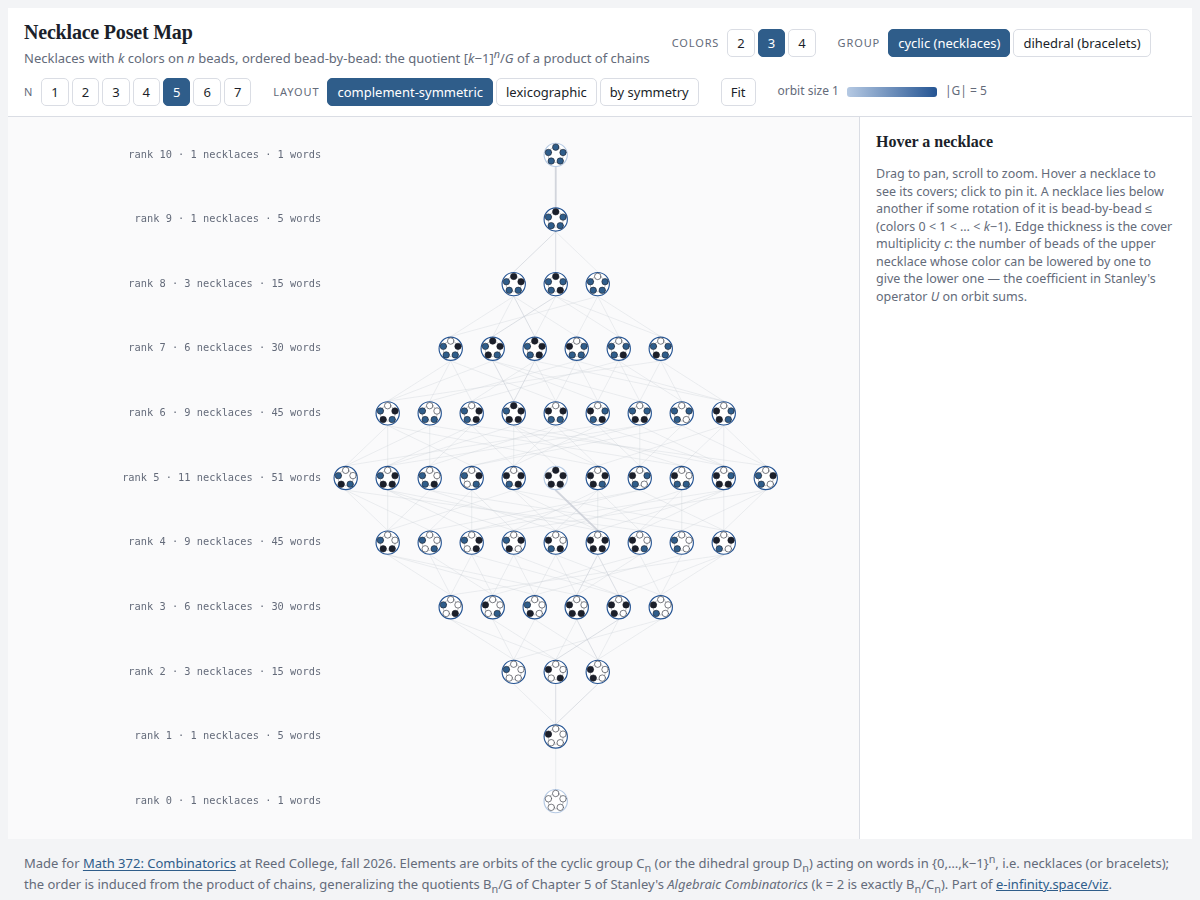
Necklaces
[k−1]n/Cn and [k−1]n/Dn
Necklaces or bracelets of n beads in 2, 3, or 4 colors, ordered bead by bead: a product of chains modulo the cyclic or dihedral group. With two colors this is exactly Stanley’s Bn/Cn. The panel gives the stabilizer, orbit size, color runs, covers, and the complementary necklace.
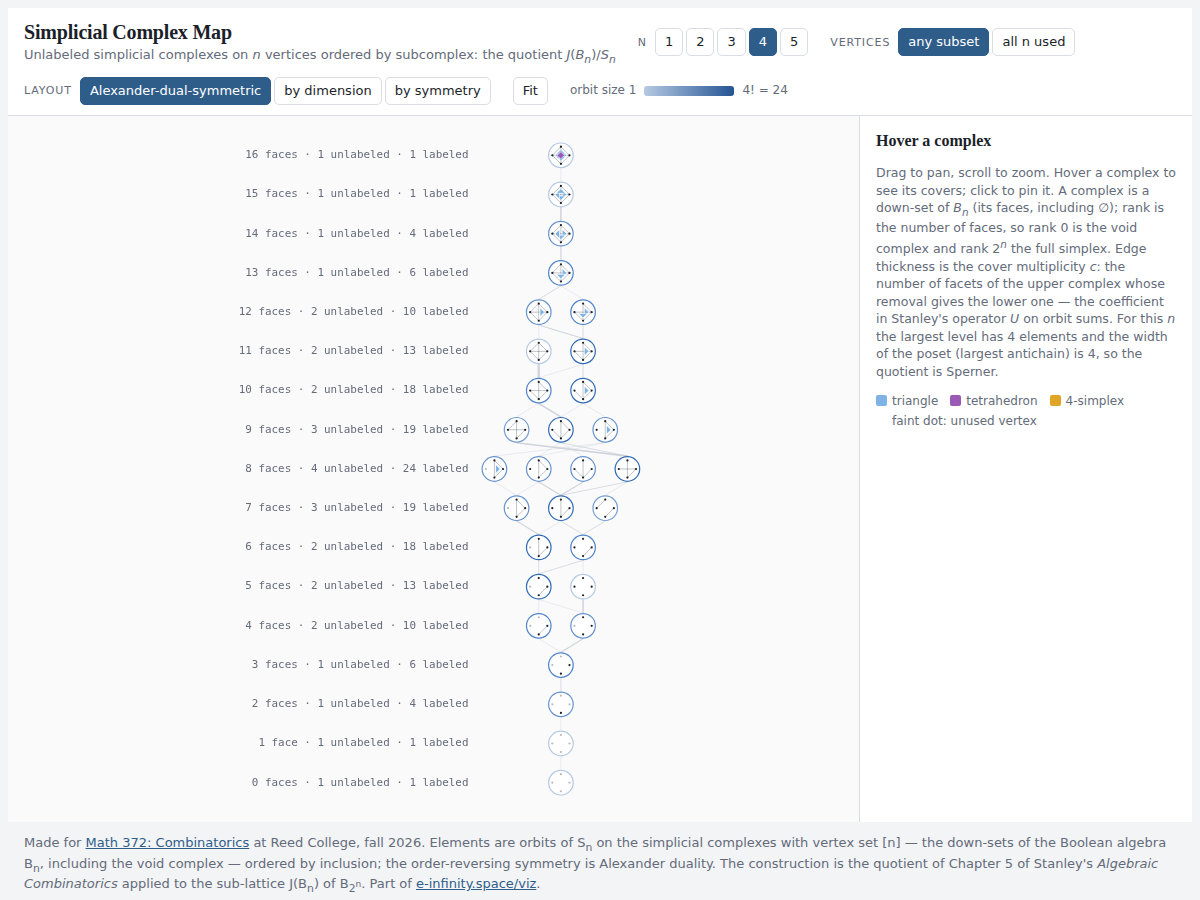
Simplicial complexes
J(Bn)/Sn
Simplicial complexes on n ≤ 6 vertices up to isomorphism, ordered by “is isomorphic to a subcomplex of”: the lattice of down-sets of Bn, modulo Sn. Rank is the number of faces, and the order-reversing symmetry is Alexander duality. The width of each quotient is computed for n ≤ 5, so you can check Sperner’s property by eye; n = 6 has 16 353 orbits, one per inequivalent monotone Boolean function.
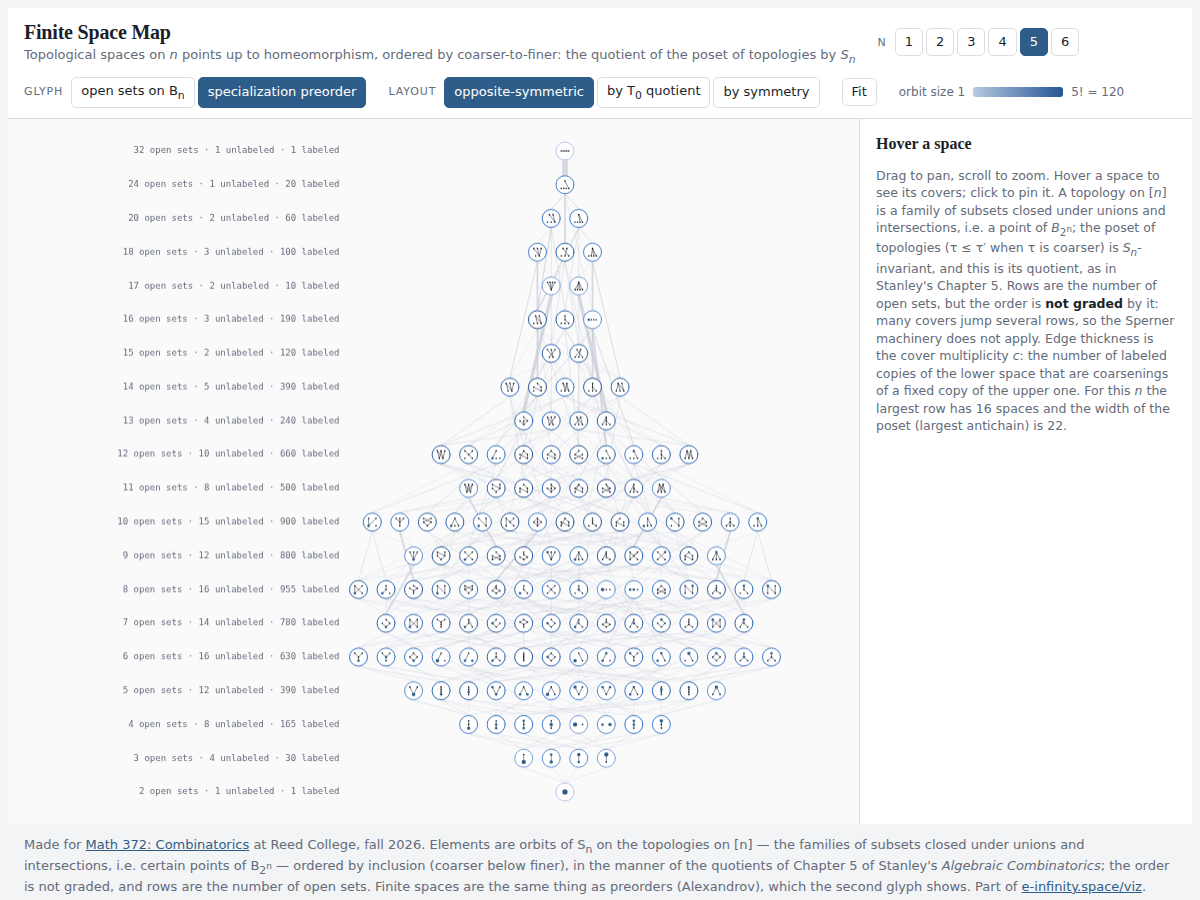
Finite spaces
topologies on [n], modulo Sn
Topological spaces on n ≤ 6 points up to homeomorphism, ordered from coarser to finer: the poset of topologies on [n] modulo Sn. Each space is drawn as its open sets marked on Bn or as its specialization preorder; the mirror symmetry swaps open and closed sets. Rows count open sets, but the order is not graded — covers jump rows — so this is the one map where Sperner’s machinery does not apply.
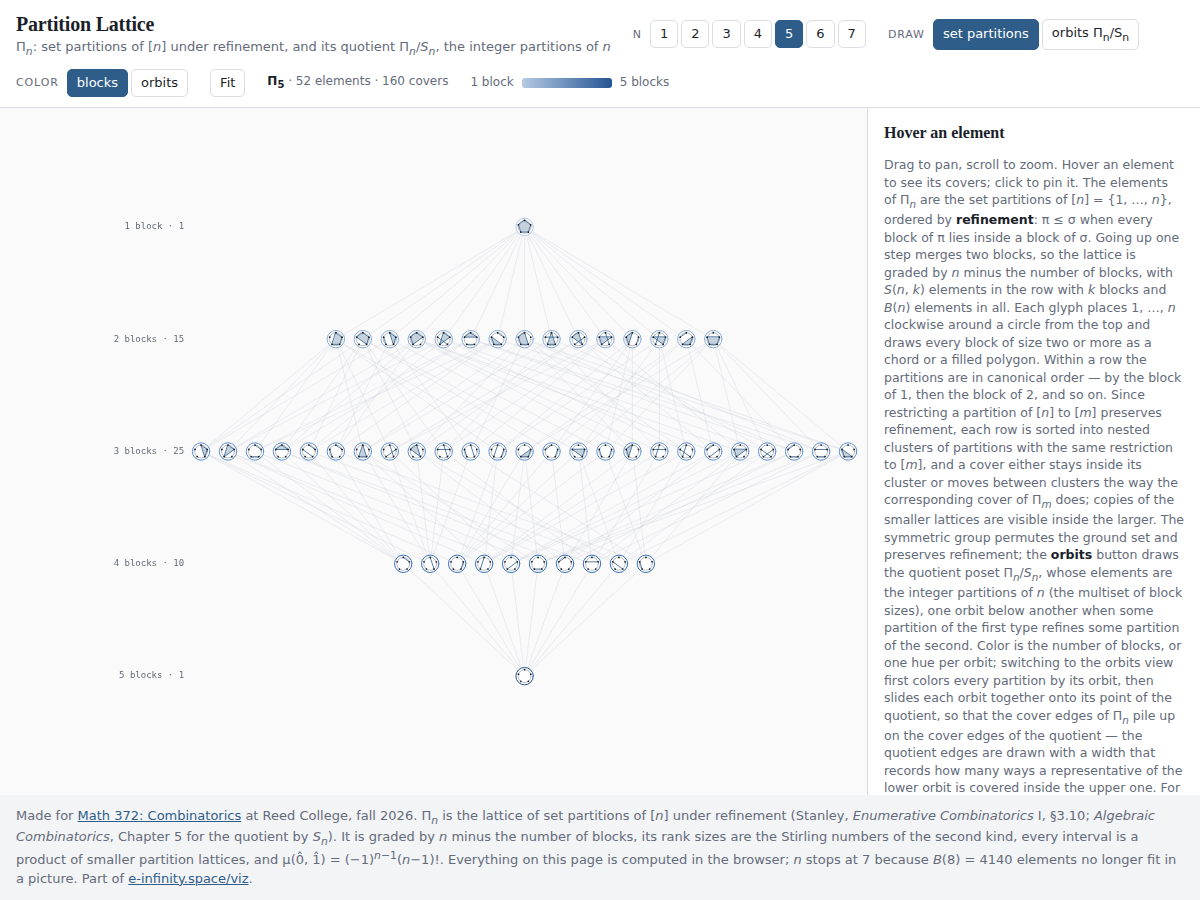
Partition lattice
Πn and Πn/Sn, n ≤ 7
Set partitions of [n] under refinement, graded by the number of blocks, with the Möbius function and the product structure of every interval in the panel. A second view collapses the Sn-orbits to the integer partitions of n.
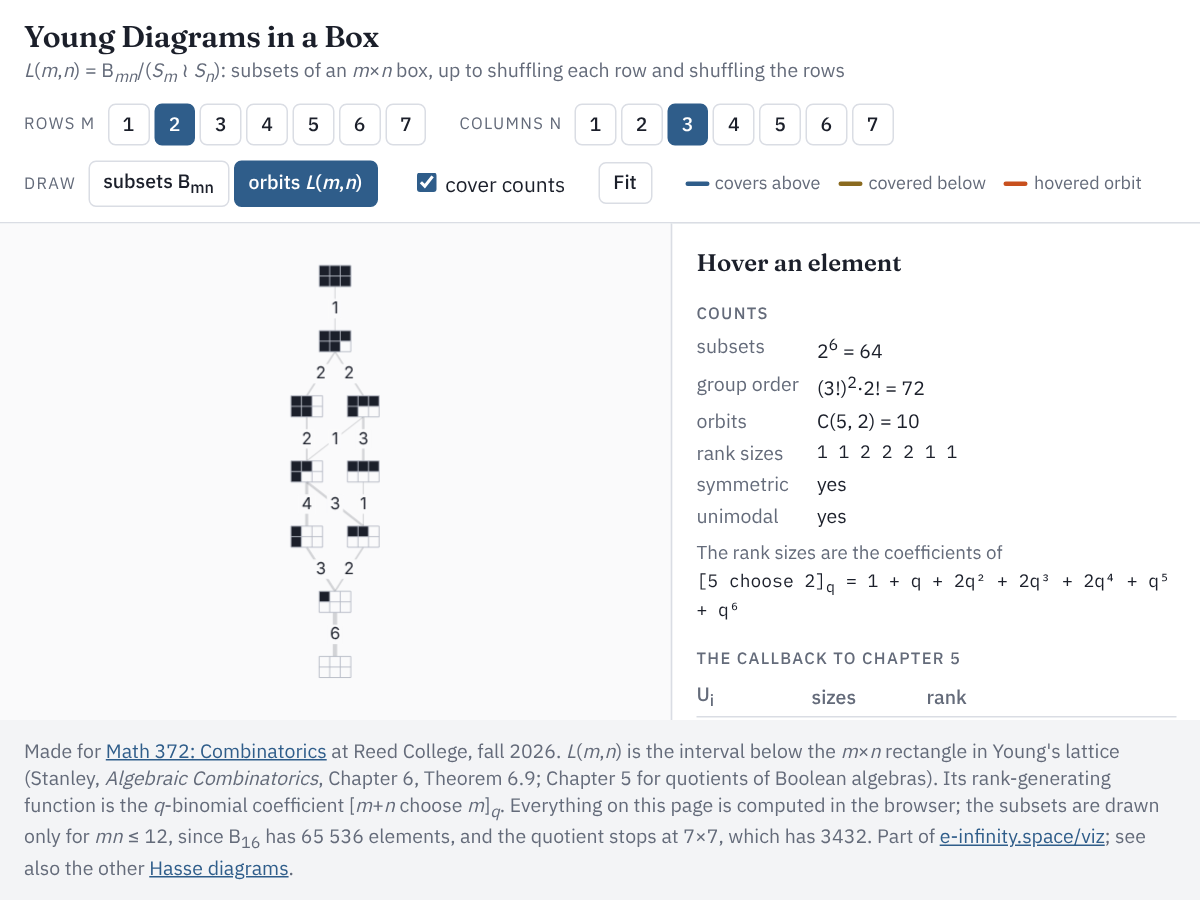
Young diagrams in a box
L(m,n) = Bmn/(Sm ≀ Sn)
Partitions whose Young diagram fits in an m×n box, ordered by containment: the interval below the rectangle in Young’s lattice. Drawn as Stanley’s quotient of the Boolean algebra on the box’s cells by the group that shuffles each row and shuffles the rows; a second view slides every subset onto its diagram. Edges carry the entries of the up operator on orbit sums, and the panel checks that it is injective below the middle, which is why the q-binomial coefficients are unimodal.
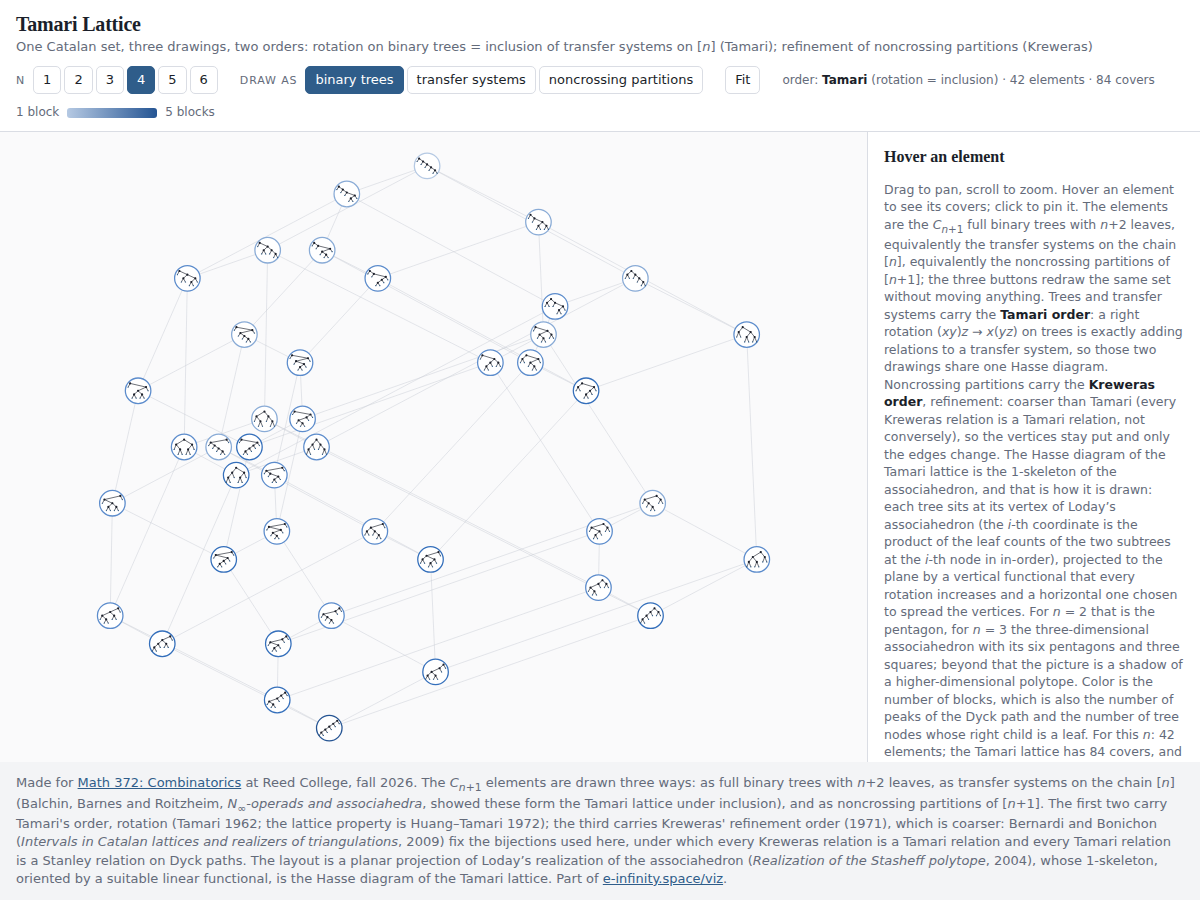
Tamari lattice
Tn+1 on trees and on transfer systems on [n]; NC(n+1)
One Catalan set drawn three ways: full binary trees with n+2 leaves, transfer systems on the chain [n], noncrossing partitions of [n+1]. The first two carry the Tamari order — a rotation is exactly adding relations — laid out as a planar projection of the 1-skeleton of Loday’s associahedron; the third carries Kreweras’ refinement order, coarser than Tamari, so toggling to it keeps every vertex in place and changes only the covers.
See also Sperner chains, a chain partition of Bn itself, and the Math 372 schedule, where these were built.